
Savings Calculators: All 11 Formulas Explained
Every Calcavio savings calculator explained - 11 tools, 11 formulas, 11 worked examples, from savings goals and CD ladders to 529 college plans.
 Daniel Okafor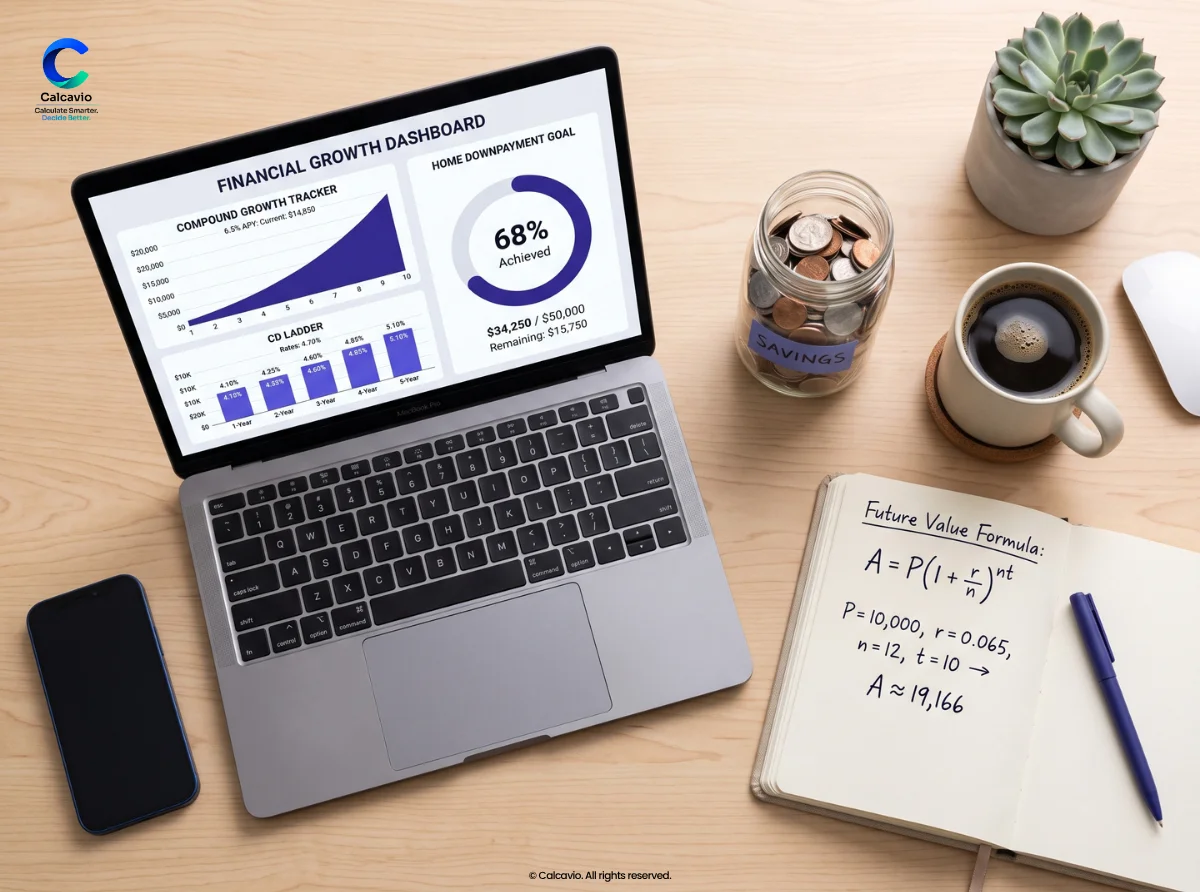
The average U.S. savings account pays 0.38% APY, according to FDIC data for August 2026. Meanwhile, top high-yield accounts pay around ten times more. On $10,000, that's the difference between $38 and roughly $425 in a single year. Savings calculators make that gap visible before it costs you anything. Each one runs on a short formula you can check by hand and this guide shows every single one.
Below are all 11 tools in Calcavio's savings category, grouped around four questions: how much to save, how fast it grows, whether to lock it in, and how to fund college. For each tool, you get the exact formula, a worked example in real dollars, and the free calculator that runs it instantly. So bookmark this page, then work through it one goal at a time.
TL;DR
What Are Savings Calculators?
Savings calculators are small, single-purpose tools. Each one applies a standard banking formula the same math your bank uses to your own numbers. Enter a goal, a balance, or a rate. In return, you get a personalized answer instead of a generic rule of thumb.
Because each tool does one job, they're faster than spreadsheets and far less error-prone than mental math. Calcavio's savings calculators cover 11 of these jobs, from setting a goal to comparing accounts. Next, this guide walks through each one, formula first.
How Much Should You Save? (Goal and Emergency Tools)
Every plan starts with a target number. These two tools set it.
Savings Goal Calculator
C = (G − P(1+i)^N) × i ÷ ((1+i)^N − 1)

where G is the goal,
P your starting balance,
i the monthly rate,
and N the months.
Say you want $20,000 in five years, starting with $2,000 at 4% APY. Your starting balance grows to about $2,442 on its own. Covering the rest takes roughly $265 a month. The Savings Goal Calculator solves this instantly and shows how a higher rate or longer timeline shrinks the deposit.
Emergency Fund Calculator
Target = essential monthly expenses × 3 to 6With $3,500 of monthly essentials, the target is $10,500 to $21,000. That cushion is rarer than it sounds. In fact, 37% of U.S. adults couldn't cover a $400 emergency entirely with cash, per the Federal Reserve's May 2025 report. So start with one month, then build. The Emergency Fund Calculator sets your number and a monthly plan to reach it.
How Fast Will Your Savings Grow? (Growth and Rate Tools)
Once the target is set, growth is next. These three tools show what your rate really does.
Savings Compound Interest Calculator
FV = P(1 + r/m)^(m·t)

P is your deposit,
r the annual rate,
m compounds per year,
t the years.
Take $10,000 at 4%, compounded monthly, for 10 years. That's 10,000 × (1.00333)^120 = about $14,908. Simple interest would earn $4,000; compounding adds roughly $908 more, because interest starts earning interest. Calcavio's Savings Compound Interest Calculator uses monthly, end-of-period compounding the same convention as your bank statement.
Savings Compound Interest Calculator
High-Yield Savings Calculator
Same FV formula

only r changes.
And r changes everything.
On $10,000 for one year, the 0.38% national average earns $38. A top high-yield account near 4.25% APY earns about $425. Same money, same year, eleven times the interest. Run your own balance through the High-Yield Savings Calculator before assuming your bank is close enough.
Table
One intro sentence above: Here's what $10,000 earns in one year at August 2026 rates.
| Account type | Rate (Aug 2026) | One-year interest on $10,000 |
|---|---|---|
| Average savings account | 0.38% APY (FDIC) | $38 |
| Average money market | 0.63% APY (FDIC) | $63 |
| Top high-yield savings | ~4.25% APY | ~$425 |
| Top 12-month CD | ~4.50% APY | ~$450 |
See what your balance could earn in the free High-Yield Savings Calculator - no formula needed.
Savings Interest Rate Finder
r = m × [(FV ÷ P)^(1/(m·t)) − 1]

the compound formula solved backwards.
Suppose you have $5,000 and want $5,700 in three years without adding deposits. You'd need (5,700 ÷ 5,000)^(1/3) − 1 ≈ 4.5% APY. That's the rate to shop for. The Savings Interest Rate Finder computes your required rate so you know instantly whether a goal needs a better account or a bigger deposit.
Should You Lock Your Money In? (CD and Account Tools)
Higher rates often come with strings lock-ups, fees, or balance tiers. These four tools price the trade-offs.
CD Calculator
FV = P(1 + r/m)^(m·t),

with APY = (1 + r/m)^m − 1
A $10,000 twelve-month CD at 4.50% APY matures at $10,450 - $450 of guaranteed interest. However, withdrawing early usually forfeits several months of interest. The CD Calculator shows the maturity value for any term, so you only lock up money you won't need.
Certificate of Deposit (CD) Calculator
CD Ladder Calculator
Rung size = total deposit ÷ number of rungs,

with staggered 1-to-n-year terms
Split $25,000 into five $5,000 rungs maturing in one through five years. Then, as each rung matures, reinvest it into a new five-year CD. As a result, you eventually hold all five-year rates while one rung still matures every year. The CD Ladder Calculator builds the whole schedule - rungs, maturity dates, and blended yield.

Money Market Account Calculator
Same compound FV formula,

often with tiered rates by balance.
The FDIC's average money market rate is 0.63% APY - $63 a year on $10,000. Yet money market accounts add check-writing and debit access that regular savings accounts lack. So the real question is whether that flexibility justifies the rate you're offered. The Money Market Account Calculator prices it for your balance and tier.
Money Market Account Calculator
Savings Account Comparison Calculator
Net yield = (interest earned − fees) ÷ balanceHere's the trap this catches. On $8,000, a 4.00% no-fee account earns $320. A 4.30% account with a $5 monthly fee earns $344 − $60 = $284. The lower headline rate wins by $36. The Savings Account Comparison Calculator runs this side by side - rates, fees, and minimums included.
How Do You Save for College? (Education Tools)
College is the largest savings goal most families ever set. These two tools size it and fund it.
529 College Savings Calculator
FV = P(1+i)^N + C × [((1+i)^N − 1) ÷ i]

Starting balance plus monthly contributions C.
Saving $250 a month for 18 years at an illustrative 6% return builds about $96,800 - from $54,000 of contributions. In a 529 plan, that growth is federally tax-free when spent on qualified education expenses. Also, contributions up to $19,000 per person in 2026 stay within the annual gift-tax exclusion, per the IRS. The 529 College Savings Calculator projects your plan year by year.
529 College Savings Calculator
College Cost Calculator
Future cost = today's cost × (1 + inflation)^yearsAverage in-state tuition and fees at public four-year colleges hit $11,950 in 2025-26, up 2.9%, per the College Board. At an illustrative 5% long-run inflation rate, that reaches about $19,500 a year in a decade. The College Cost Calculator projects the full multi-year bill - which becomes the goal your 529 plan needs to hit.
Which Savings Calculator Should You Use First?
The honest answer: The one attached to your next decision. Use this table to match your situation to a starting tool.
| Your situation | Start with | The math |
|---|---|---|
| No cash cushion yet | Emergency Fund | essential expenses × 3–6 |
| Saving for one big purchase | Savings Goal | C = (G − P(1+i)^N) × i ÷ ((1+i)^N − 1) |
| Money idling at a big bank | High-Yield Savings | FV = P(1 + r/m)^(m·t) |
| Cash you won't touch for years | CD + CD Ladderv | rung = deposit ÷ rungs |
| Want checkbook flexibility | Money Market + Comparison | net yield = (interest − fees) ÷ balance |
| A child under 10 | College Cost + 529 | cost × (1 + inflation)^years |
Together, these tools form one ladder: set the target, grow it, lock in what you can, and fund the long goals. Because each answer feeds the next, run them in that order once. Ultimately, that's why savings calculators beat generic advice - every step is your number, not an average.
Calcavio's Verdict
The verdict: A free 11-tool kit that covers the whole savings ladder - target, growth, lock-up, and college - with every formula published is genuinely rare. By contrast, most alternatives show one widget per page and hide the math.
Best for: Anyone parking cash at a near-zero rate, building a first emergency fund, or facing one concrete choice - HYSA vs CD, ladder vs lump sum, 529 vs taxable.
Skip it if: You need personalized tax or investment advice; calculators inform those conversations, they don't replace them.
Pros and cons
- Every formula is published and checkable by hand
- No signup, runs privately in your browser
- The tools interconnect - the College Cost output becomes the 529 goal, and the Rate Finder tells you which account makes a goal feasible
- Rate outputs are estimates that move with the market
- 529 tax treatment varies by state and isn't modeled in full
Standout:
Frequently asked questions
What is a good interest rate on a savings account in 2026?+
Is a CD better than a high-yield savings account?+
How much should I have in an emergency fund?+
Is a 529 plan better than a regular savings account for college?+
How does a CD ladder actually work?+

The Bottom Line: Run Your Savings Numbers
Conclusion
You don't need all 11 tools today. Instead, three takeaways are enough. Your account rate matters as much as your deposit amount. Every answer in this guide is a formula you can check by hand. And each result feeds the next - the college cost becomes the 529 goal, the required rate picks the account. Because savings calculators only pay off when you enter your numbers, start small. Begin with the Savings Goal Calculator - every other number builds on it. So, which result surprised you more: what your bank pays, or what a ladder could earn? Tell us in the comments.
Disclaimer
Sources
- National average savings rate 0.38% APY; money market average 0.63% APY — FDIC - National Rates and Rate Caps (August 2026)
- Personal Saving Rate - 2.7% in June 2026 — U.S. Bureau of Economic Analysis
- 37% could not cover a $400 emergency with cash — Federal Reserve - Economic Well-Being of U.S. Households in 2024 (May 2025)
- Public four-year in-state tuition and fees $11,950 in 2025-26, up 2.9% — College Board - Trends in College Pricing 2025
- $19,000 annual gift-tax exclusion threshold for 2026 contributions — IRS - 529 Plans: Questions and Answers
Run the numbers yourself
See your exact numbers in seconds — free, no signup.
Try the Savings Goal CalculatorLatest Articles

Tax Calculators: Every Formula Behind All 25 Tools (2026)
Every tax calculator on Calcavio, explained with its exact 2026 formula - from US federal brackets to UK VAT, Canadian rates, and Australian GST.

Personal Finance Calculators: All 15 Formulas Explained
Every Calcavio personal finance calculator explained - 15 tools, 15 formulas, 15 worked examples, from the 50/30/20 budget to your FI number.

Insurance Calculators: Every Formula, Worked Out for 2026
Every major insurance decision has a formula behind it. Here are all nine - worked out with verified 2026 numbers you can check by hand.