
Retirement Calculators: 30 Free Tools & Every Formula
All 30 Calcavio retirement calculators explained - the exact formula behind each one, with verified 2026 numbers for the US, UK, Canada, and Australia.
 Priya Raghunathan10 min read
Retirement Calculators: 30 Tools & the Math Behind Them
Most people spend more time planning a two-week holiday than checking the one number that decides thirty years of their life. That's not a character flaw - it's a math problem. Retirement calculators exist to solve it. But most of them hide the math behind jargon and tax rules nobody explains.
This guide fixes that. It walks through all 30 free Retirement Calculators on Calcavio, covering the US, UK, Canada, and Australia. For each tool, you get the exact formula with verified 2026 numbers. No black boxes. So you'll see precisely how each one turns your inputs into an answer and which calculator fits which decision.
Bookmark it, skim to your country, and run your numbers as you go.
What does a retirement calculator actually do?
TL;DR
A retirement calculator estimates how much money you'll have - or need - by a target retirement age. It projects your savings, contributions, and investment growth. Most tools run on the future value formula, FV = P(1+i)^N + C × [((1+i)^N − 1) / i]. Then they compare the result against your expected retirement spending.
Here's that core formula unpacked, because it powers roughly a third of the tools below. P is your current balance. i is the monthly return (annual rate ÷ 12). N is the number of months, and C is your monthly contribution. Also worth knowing: Calcavio's retirement tools use monthly compounding with end-of-period contributions. A calculator that compounds annually will show a lower number for the same inputs.
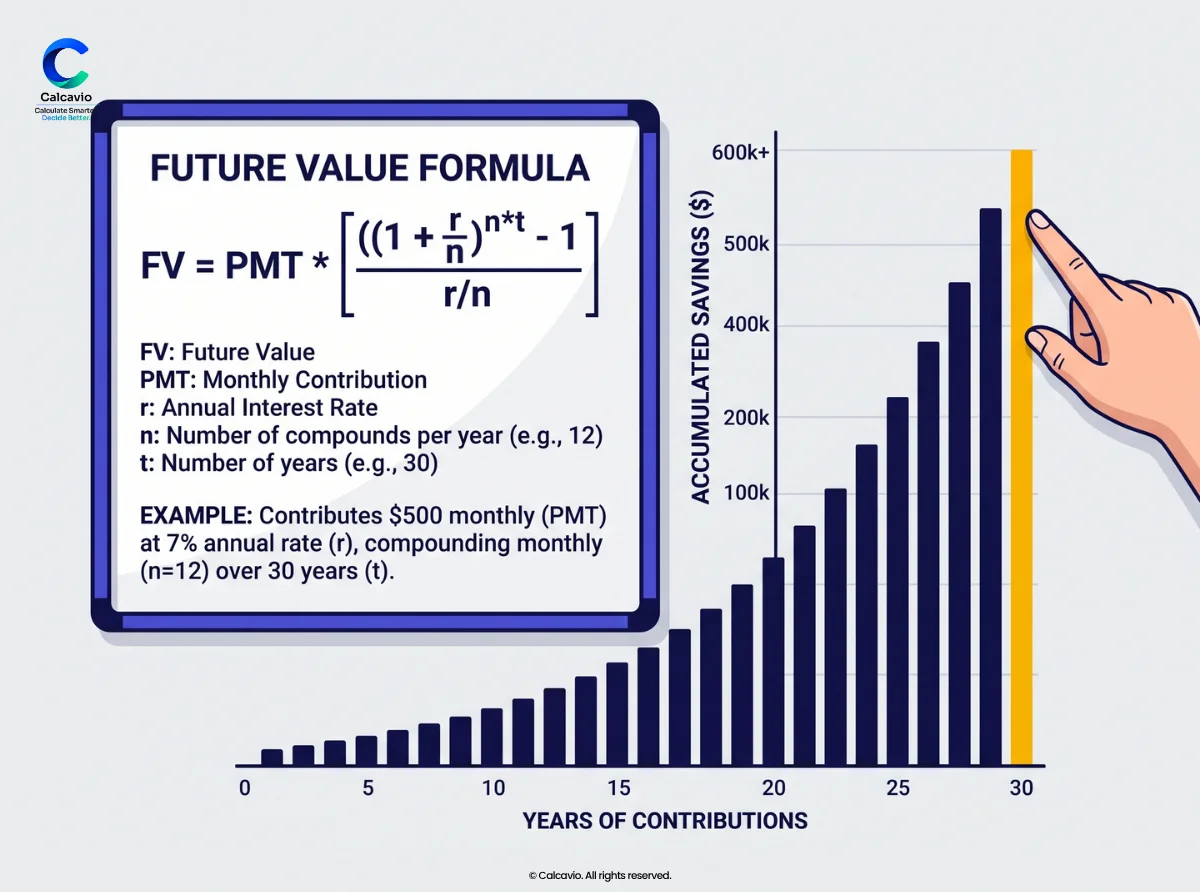
A worked example: contribute $500 a month at an 8% average annual return, starting from zero. After 30 years, FV = 500 × [((1 + 0.0066667)^360 − 1) / 0.0066667] ≈ $745,180. You put in $180,000. Growth did the other $565,000. In short, that gap between contributions and compounding is the entire argument for starting early.
One honest caveat before the formulas: every projection depends on the return you assume. An 8% average is in line with long-run stock market history. But no return is guaranteed, and inflation quietly shrinks what a future dollar buys. So run your numbers at 5% and 8%. Then treat the range — not either endpoint — as your answer.
Want the math done for you? Run the free Retirement Planner - no formula needed, no signup.
US retirement calculators: formulas and 2026 limits
Retirement Planner
The Retirement Planner is the all-in-one projection. It grows your current savings and monthly contributions to retirement age. Then it checks the result against your spending goal.
FV = P(1+i)^N + C × [((1+i)^N − 1) / i]

Monthly rate i,
Months N,
end-of-period contributions.
Say you're 40 with $80,000 saved, adding $700 a month at 7%. By 65, FV = 80,000(1.0058333)^300 + 700 × [((1.0058333)^300 − 1) / 0.0058333] ≈ $1.02 million. That single run tells you more than a year of vague worrying.
401(k) Calculator
The 401(k) Calculator projects your workplace plan, including the employer match - the part people most often leave on the table.
Annual contribution =
(salary × your deferral %) + (salary × match % up to the match cap)

1. Capped at $24,500 employee-side for 2026 (IRS),
2. Then compounded with the future value formula.

Catch-ups:
+$8,000 at 50+, or +$11,250 at ages 60–63.

Combined employee + employer ceiling: $72,000.A 100% match on your first 4% of salary is an instant, guaranteed doubling of that money. Nothing else in finance hands you that.
Traditional IRA Calculator
The Traditional IRA Calculator models pre-tax contributions that grow tax-deferred; withdrawals are taxed as income.
Same future value math,
Capped at $7,500 for 2026 (+$1,100 catch-up at 50+).

Upfront tax saving = contribution × your marginal rate — $7,500 at a 22% marginal rate trims this year's tax bill by $1,650. Deductibility phases out at higher incomes if a workplace plan covers you (IRS rules).Roth IRA Calculator
The Roth IRA Calculator flips the tax deal: you contribute after-tax dollars, and qualified withdrawals growth included come out tax-free.
FV = C_annual × [((1+r)^n − 1) / r] with after-tax contributions;

Spendable value = FV (no tax on qualified withdrawals).

For 2026, eligibility phases out at $153,000–$168,000 of income (single) and $242,000–$252,000 (married filing jointly), per IRS Notice 2025-67.
Roth vs. Traditional IRA Calculator
The Roth vs. Traditional IRA Calculator answers the real question: which one leaves you more spendable money?
Traditional after-tax value = FV × (1 − t_retirement);

Roth value = FV × (1 − t_now) applied to contributions upfront.

If your tax rate never changes, they tie.
The decision is a bet on t_now vs t_retirement.
Worked: $7,500/year for 25 years at 8% grows to ~$51,360 per year-one contribution equivalent... simplified to one contribution: $7,500 × 1.08²⁵ ≈ $51,360. Traditional at a 12% retirement rate nets ~$45,200; Roth funded at a 22% current rate nets ~$40,060.
Lower expected retirement bracket → Traditional wins; Higher → Roth wins.
Roth vs. Traditional IRA Calculator
401(k) Roth vs. Traditional Calculator
The 401(k) Roth vs. Traditional Calculator runs the same comparison at 401(k) scale up to $24,500 a year (2026), where the stakes are three times larger than the IRA version. Same formula, bigger consequences. One 2026 wrinkle: if you earned $150,000+ in prior-year wages, catch-up contributions must now be Roth (SECURE 2.0).
401(k) Roth vs. Traditional Calculator
Social Security Calculator
The Social Security Calculator estimates your benefit from your earnings history and claiming age.
SSA averages your highest 35 years of indexed earnings into AIME,
then applies the bend-point formula: PIA = 90% of the first slice of AIME + 32% of the middle slice + 15% above (bend points adjust annually — see SSA).

Claiming at 62 with a full retirement age of 67 cuts your check ~30%; waiting to 70 adds 8% per year (+24% total).

Benefits rise 2.8% in 2026 under the announced COLA.RMD Calculator
The Required Minimum Distribution RMD Calculator computes the withdrawal the IRS forces from pre-tax accounts starting at age 73 (75 for those born 1960 or later).
RMD = account balance on Dec 31 last year ÷ IRS Uniform Lifetime Table factor.

At 75 with $500,000, the factor is 24.6: 500,000 ÷ 24.6 ≈ $20,325. Miss it and the excise tax is brutal - up to 25% of the shortfall.
Required Minimum Distribution (RMD)
Retirement Nest Egg Calculator
The Retirement Nest Egg Calculator answers "how long will my money last?"
N = −ln(1 − (r × B) / W) / ln(1 + r)

Balance B, periodic withdrawal W, periodic return r.

If r × B ≥ W, your portfolio's growth covers withdrawals and the money never runs out on paper.

Reality adds sequence risk - a bad market early in retirement does damage the averages hide which is why testing multiple return scenarios matters.
Retirement Nest Egg Calculator
Early Retirement (FIRE) Calculator
The Early Retirement (FIRE) Calculator finds your financial-independence number and the year you hit it.
FI number = annual expenses ÷ safe withdrawal rate.

At the classic 4% rule that's expenses × 25

Spend $40,000 a year and your target is $1,000,000.

Years to FI come from solving the future value formula for N.

The 4% rule was built on 30-year US retirements; many early retirees plan around 3.25–3.5% for longer horizons.
Early Retirement / FIRE Calculator
Pension vs. Lump Sum Calculator
The Pension vs. Lump Sum Calculator compares a buyout offer against the pension's stream of payments.
Present value of the pension = PMT × [1 − (1+r)^−n] / r.

A $24,000/year pension over 25 years discounted at 5% is worth 24,000 × 14.094 ≈ $338,300.

If the lump sum on the table is $250,000, the annuity is the mathematically stronger offer before even counting longevity protection.
Pension vs. Lump Sum Calculator
Defined Benefit Pension Calculator (US)
The Defined Benefit Pension Calculator estimates a traditional pension.
Annual benefit = accrual rate × years of service × final average salary.

A 1.5% accrual over 30 years on an $80,000 final average salary pays 0.015 × 30 × 80,000 = $36,000 a year for life.
Defined Benefit Pension Calculator (US)
403(b) Calculator
The 403(b) Calculator is the 401(k) math for teachers, healthcare, and nonprofit workers: same $24,500 limit and catch-ups for 2026, same future value formula - plus a quirk: employees with 15+ years at qualifying employers may add up to $3,000/year (capped at $15,000 lifetime).
457(b) Plan Calculator
The 457(b) Plan Calculator covers government and some nonprofit plans. Limit: $24,500 (2026). Two superpowers: a pre-retirement catch-up that can double the limit to $49,000 in the three years before retirement age, and no 10% early-withdrawal penalty once you separate from your employer — the quiet favorite of early retirees in public service.
72(t) SEPP Calculator
The 72(t) SEPP Calculator computes penalty-free early withdrawals via Substantially Equal Periodic Payments.
PMT = B × r / (1 − (1+r)^−n)

Balance B, an interest rate up to the greater of 5% or 120% of the federal mid-term rate (IRS Notice 2022-6), and n from the IRS single life expectancy table.

A 55-year-old with $400,000 at 5% over a 31.6-year factor gets roughly $25,400 a year. Warning: once started, payments are locked for 5 years or until 59½, whichever is longer breaking the schedule triggers retroactive penalties.UK pension calculators: formulas for 2026/27
The UK system splits into the State Pension, workplace schemes, and private pensions (SIPPs) with its own tax rules around allowances and lump sums. All figures below are 2026/27 tax year.
UK Workplace Pension Calculator
The UK Workplace Pension Calculator projects your pot from combined contributions.
Annual contribution = (employee % + employer % ) × pensionable earnings, plus basic-rate tax relief on your share, compounded with the future value formula.
Auto-enrolment minimums: 8% total, of which at least 3% is employer money, applied to the qualifying earnings band (£6,240–£50,270 in recent tax years (confirm the current band on GOV.UK).
UK Workplace Pension Calculator
UK State Pension Calculator
Weekly pension = (qualifying NI years ÷ 35) × £241.30
The 2026/27 full new State Pension after the 4.8% triple-lock rise (House of Commons Library), worth £12,547.60 a year.


You need 10 years for anything and 35 for the full amount:
28 years gets 28/35 × 241.30 = £193.04 a week.

State Pension age is currently 66,
rising to 67 between 2026 and 2028.
UK Final Salary / Defined Benefit Pension Calculator
Annual pension = (years in scheme ÷ accrual denominator) × final (or career-average) salary.

A 1/60th scheme after 25 years on £45,000 pays 25/60 × 45,000 = £18,750 a year, typically inflation-linked - which is why transferring out of a DB scheme is rarely wise and legally requires advice above £30,000.
UK Final Salary / Defined Benefit Pension Calculator
UK SIPP Calculator
Gross contribution = net contribution ÷ 0.80

Pay in £80 and basic-rate relief tops it to £100 automatically; higher-rate taxpayers reclaim more via self-assessment.

The gross amount then compounds with the future value formula.
That built-in 25% uplift on day one is the single best mathematical feature of UK pension saving.
UK Pension Drawdown Calculator
The same drawdown longevity math as the Nest Egg tool

N = −ln(1 − (r × B) / W) / ln(1 + r)

Applied to your pot after any tax-free cash.

A £300,000 pot drawing £15,000 a year at 5% growth lasts on paper indefinitely (growth covers it); at £24,000 a year it runs out in roughly 20 years. Small changes in the withdrawal, big changes in the outcome.
UK Pension Drawdown Calculator
UK Pension Tax-Free Lump Sum Calculator
Tax-free cash = 25% × pot, capped by the Lump Sum Allowance of £268,275.

A £400,000 pot releases £100,000 tax-free;
the cap bites once your pot passes £1,073,100.
UK Pension Tax-Free Lump Sum Calculator
UK Annual Allowance / Pension Input Calculator
Compare total pension input against the £60,000 annual allowance (2026/27).

For DB schemes, input = (pension growth above inflation) × 16.

Tapering: £1 of allowance lost per £2 of adjusted income above £260,000, floored at £10,000.

Unused allowance carries forward three years the tool nets all of it before any tax charge.
UK Annual Allowance / Pension Input Calculator
UK Auto-Enrolment Pension Calculator
Eligibility check (age 22 to State Pension age, earnings above the £10,000 trigger) + the 8% minimum contribution math from the workplace tool.

Its real job is showing the cost of opting out:
a 30-year-old on £32,000 who opts out isn't saving ~£110 of personal contributions a month they're refusing roughly £2,060 a year of combined employer money and tax relief.
UK Auto-Enrolment Pension Calculator
UK Annuity Calculator
Annual income = pot × annuity rate.


Rates move with age, health, and gilt yields;
recent best-buy level single-life rates for a 65-year-old have hovered around 7%, so £100,000 buys about £7,000 a year for life (illustrative - always compare live quotes).

Inflation-linked and joint-life options start lower.
UK reader?
Start with the free UK Workplace Pension CalculatorIt does this math in seconds.
UK Workplace Pension Calculator
Canadian retirement calculators: RRSP, CPP, OAS, and TFSA
RRSP Calculator
New contribution room = 18% × last year's earned income,
capped at $33,810 for 2026 (CRA),
minus any pension adjustment,
plus unused room carried forward.

The refund kicker: tax saved = contribution × marginal rate

$10,000 at a 40% marginal rate returns $4,000 at tax time.

Growth follows the standard future value formula,
tax-deferred until withdrawal.CPP Benefits Calculator
CPP replaces about 25% of your average pensionable earnings
(rising toward 33.33% under the enhancement),
scaled by your contribution history.

Timing math:
−0.6% per month before 65 (−36% at 60) and +0.7% per month after (+42% at 70).

The January 2026 maximum at 65 is $1,507.65/month
but the average new pension is $877.01 (Canada.ca, April 2026). Most people are closer to the average than the max; check your Statement of Contributions before assuming.
CPP Benefits Calculator (Canada)
OAS Calculator
OAS = (years resident in Canada after 18 ÷ 40) × full pension, needing 10+ years to qualify.

Full monthly OAS is $742.31 (65–74) or $816.54 (75+) for the January–March 2026 quarter,
indexed quarterly.

The clawback: recovery tax = 15% × (net income − $93,454) for the 2025 income year high earners can lose every dollar of it.TFSA Calculator
Room = sum of every year's limit since you turned 18 (2009 onward)
Contributions + last year's withdrawals.

The 2026 limit is $7,000; someone eligible since 2009 who never contributed has $109,000 of room (CRA).

Growth is the future value formula with a beautiful twist: every dollar of it comes out tax-free, and withdrawals don't claw back OAS.Australian retirement calculators: super and the Age Pension
Australian Superannuation Calculator
Employer SG = 12% × ordinary time earnings
(the legislated final rate from 1 July 2025, per the ATO — and from 1 July 2026, paid every payday).

Contributions land minus 15% contributions tax, so net inflow = 0.85 × SG, then compound: on an $85,000 salary that's $10,200 gross, $8,670 net a year. At 7% over 30 years, that alone builds roughly $875,000 - before any salary growth or extra contributions.
Australian Superannuation Calculator
Australian Age Pension Eligibility Calculator
Three gates:
Age 67+, Australian residency (normally 10+ years),
and means tests (Services Australia).

Income test:
The pension reduces by 50 cents per dollar over the income free area.

Assets test:
$3.00 per fortnight per $1,000 over the threshold.
You get the lower result of the two tests; thresholds index regularly,
so run current figures rather than remembered ones.
Australian Age Pension Eligibility Calculator
Which retirement calculator should you use first?
Thirty tools sounds like a lot. You need two or three. Here's the honest routing table:
| Your situation | Start with | Then run |
|---|---|---|
| "Am I on track?" (any country) | Retirement Planner | Nest Egg Calculator |
| US employee with a match | 401(k) Calculator | Roth vs. Traditional |
| Deciding Roth vs. pre-tax | Roth vs. Traditional IRA | 401(k) Roth vs. Traditional |
| Retiring before 59½ (US) | FIRE Calculator | 72(t) SEPP |
| Pension buyout offer on the table | Pension vs. Lump Sum | Nest Egg Calculator |
| UK saver | UK Workplace Pension | State Pension + Tax-Free Lump Sum |
| Canadian saver | RRSP Calculator | TFSA + CPP timing |
| Australian saver | Superannuation Calculator | Age Pension Eligibility |
The pattern:One accumulation tool (will I have enough?) + Plus One decision tool (what should I choose?).
Everything else is refinement.
Calcavio's Verdict
The verdict: You don't need all 30 calculators - you need the two or three that match your country and accounts, run with honest assumptions, once a year.
Best for: Anyone who wants their retirement number grounded in actual formulas and current-year government figures instead of vibes.
Skip it if: A fee-only adviser already models your plan annually with Monte Carlo analysis. In that case, these tools become a second opinion, not the plan.
Pros and cons
- Formula-transparent math you can verify by hand
- Covers all four major English-speaking systems with 2026 constants
- Free, instant, no signup
- Outputs are only as good as your return and inflation assumptions
- Government limits and thresholds change every year, so results have a shelf life
- Simple projections can't model sequence-of-returns risk
Standout: This is the only guide we know of that puts every formula - US, UK, Canada, and Australia - on one page with verified 2026 constants, so you can check the calculator's work instead of trusting it blindly.
Frequently asked questions
How much money do I need to retire?+
How long will $1 million last in retirement?+
What are the retirement contribution limits for 2026?+
Are online retirement calculators accurate?+
Do retirement calculators include Social Security or the State Pension?+

Three takeaways from all 30 formulas:
- The same future value equation drives most of retirement math. Master it once and every projection makes sense.
- Tax wrappers - 401(k)s, TFSAs, SIPPs, super - are where governments hand you free money. The formulas above show exactly how much.
- Your assumptions matter more than your tool. So run a retirement planner with conservative and optimistic cases, every year.
Your number is thirty seconds away. Pick your country's calculator from the Full Retirement Collection and run it now - free, instant, no signup. What surprised you most about your result? Tell us in the comments.
Sources
- 401(k) limit increases to $24,500 for 2026; IRA limit increases to $7,500 (IR-2025-111, Nov 2025) — IRS
- Retirement topics: 401(k) contribution limits (2026 catch-up figures) — IRS
- 2026 Cost-of-Living Adjustment Fact Sheet (2.8% COLA) — SSA
- Benefits Uprating 2026/27 (State Pension £241.30/week) — House of Commons Library
- MP, DB, RRSP, DPSP, TFSA limits and YMPE (RRSP $33,810; TFSA $7,000, 2026) — CRA
- How much you could receive (Jan 2026 max $1,507.65; Apr 2026 average $877.01) — Canada.ca - CPP:
- Super guarantee (12% rate; payday super from 1 July 2026) — ATO
- Age Pension (age 67; income and assets tests) — Services Australia
- How America Saves 2025 (average participant balance $148,153) — Vanguard
- 72(t) interest-rate rule (greater of 5% or 120% mid-term AFR) — IRS Notice 2022-6
Disclaimer
Run the numbers yourself
See your exact numbers in seconds — free, no signup.
Try the Retirement PlannerLatest Articles

Tax Calculators: Every Formula Behind All 25 Tools (2026)
Every tax calculator on Calcavio, explained with its exact 2026 formula - from US federal brackets to UK VAT, Canadian rates, and Australian GST.

Savings Calculators: All 11 Formulas Explained
Every Calcavio savings calculator explained - 11 tools, 11 formulas, 11 worked examples, from savings goals and CD ladders to 529 college plans.

Personal Finance Calculators: All 15 Formulas Explained
Every Calcavio personal finance calculator explained - 15 tools, 15 formulas, 15 worked examples, from the 50/30/20 budget to your FI number.