
New vs Used Car Financing Break Even: Find Your Price
A lower used-car price can still mean higher loan repayments. Compare matched offers, find the used borrowing threshold, and check ownership costs separately.
 Nathan Cole

A new vs used car financing break even comparison answers one question: how low must the used-car loan be to match the new-car payment? A cheaper car can still have the higher payment. The rate and loan term help explain why.
Cox Automotive’s October 16, 2026 report provides recent price context. However, a national average is not a quote for a car that suits your needs.
Instead, compare written offers with equal terms and upfront contributions. Afterward, check condition, insurance, and resale.
What changed in used-car pricing?
Cox Automotive’s October 16, 2026 report put September’s average used listing price at USD 27,235. That was the highest monthly average since December 2022. These are dealer asking prices, not completed sales. Therefore, compare written quotes for similar cars. This market average alone cannot tell you which loan costs less.
Separately, Kelley Blue Book’s October 13 report put September’s average new-car transaction price at USD 50,562. However, do not subtract the used listing average from it. The figures cover different cars and price measures. Both reports come from Cox Automotive, so they are not independent sources.
The Car Loan Calculator provides the payment calculation behind this comparison.
Which quote fields must match?
First, match body style, equipment, drivetrain, and suitability. Record age, miles, history, and condition separately. Worn tires aren’t a financing discount.
Next, use this new vs used car financing break even worksheet to record both offers. Ask for written, itemized quotes. Do not rely on advertised “from” payments.
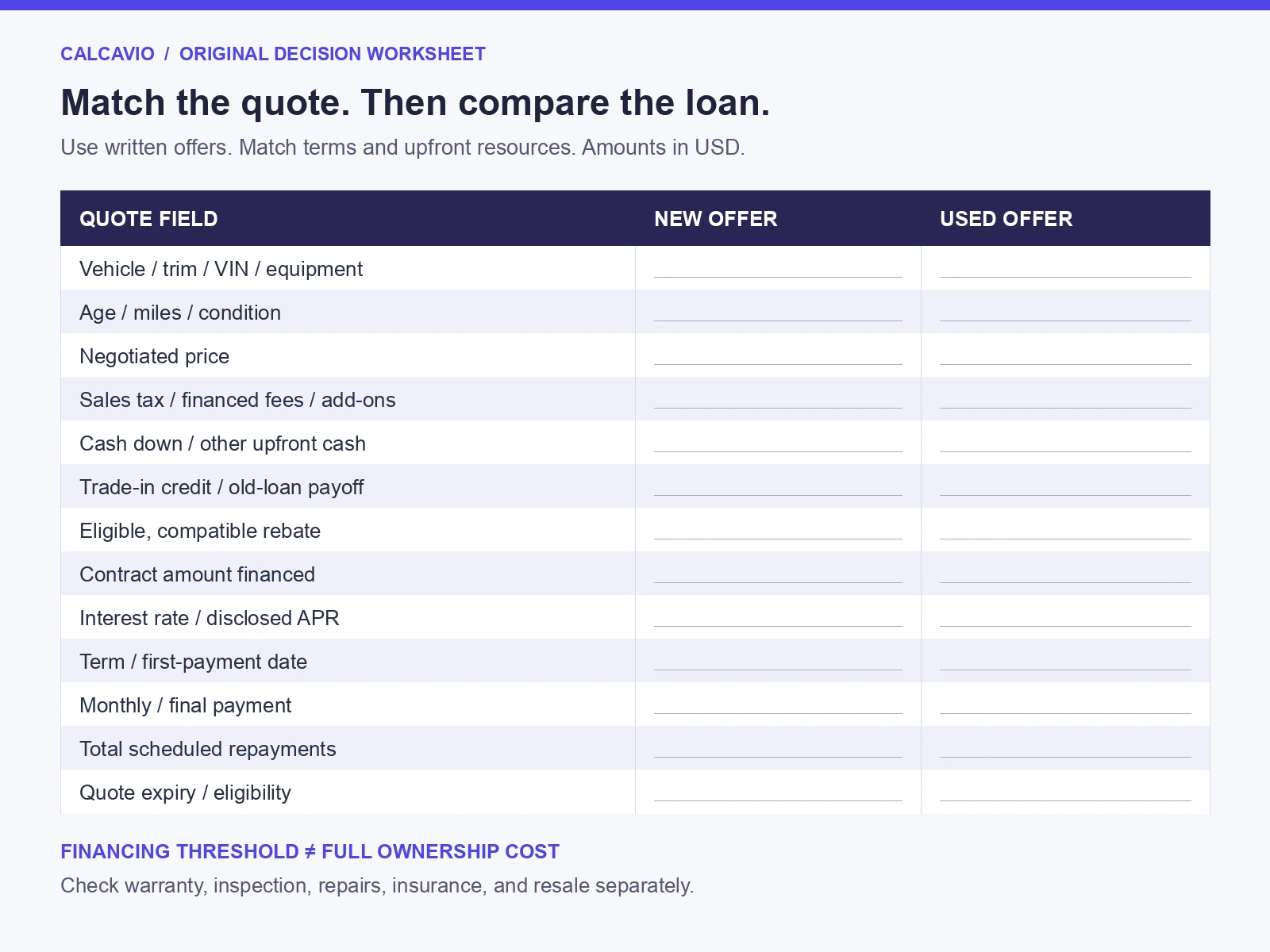
Fill both columns from written quotes; compare ownership costs separately.
| Quote field | New-car offer | Used-car offer |
|---|---|---|
| Vehicle details — make, model, trim, drivetrain, equipment, and VIN | — | — |
| Age, mileage, and condition — model year, miles, inspection findings, and vehicle history | — | — |
| Negotiated vehicle price (USD) — before taxes, fees, and financing | — | — |
| Sales tax, financed fees, and add-ons (USD) — list each separately | Sales tax: —; financed fees: —; add-ons: — | Sales tax: —; financed fees: —; add-ons: — |
| Cash down and other upfront cash (USD) — separate the down payment from fees paid in cash | Cash down: —; other upfront cash: — | Cash down: —; other upfront cash: — |
| Trade-in credit and old-loan payoff (USD) — record both to identify net trade equity | Trade-in credit: —; payoff: — | Trade-in credit: —; payoff: — |
| Eligible, compatible rebate (USD) — include only rebates allowed with the quoted financing | — | — |
| Contract amount financed (USD) — the actual amount borrowed | — | — |
| Contractual interest rate and disclosed APR (%) — record separately if different | Interest rate: —; APR: — | Interest rate: —; APR: — |
| Loan term and first-payment date — match payment counts and timing | Months: —; first payment: — | Months: —; first payment: — |
| Monthly payment and final payment (USD) — identify any different final payment or balloon | Monthly: —; final: — | Monthly: —; final: — |
| Total scheduled repayments (USD) — use the lender’s full payment schedule | — | — |
| Quote expiry and eligibility — expiration date, borrower qualifications, location restrictions, and incentive conditions | — | — |
Also, match upfront resources, including trade equity. Otherwise, extra contributions can make one offer look cheaper.
The Consumer Financial Protection Bureau explains that APR includes interest and certain loan fees. As a result, APR can differ from the contract interest rate. Use the contract rate and payment schedule to check a real loan. Dividing a fee-inclusive APR by 12 may not reproduce its payment.
How do you calculate the new vs used car financing break even?
To find the new vs used car financing break even, start with the new offer’s monthly payment. Then find the used loan amount that gives the same payment at the used rate. This method assumes a fixed rate, equal monthly payments, and full payoff by the last payment.
r = annual interest rate as a decimal / 12
M = P × r / [1 − (1 + r)^(-n)]
Used amount-financed threshold = M_new × [1 − (1 + r_used)^(-n)] / r_used
Here, P is borrowing, M is payment, and n is months. At zero interest, M = P/n; the threshold is M_new × n. Future cash flows aren’t discounted.
What does the worked example show?
Illustration prepared October 19, 2026, not lender offers. Compare similar cars over 60 months. Assume fixed annual rates of 4.9% for new and 10.9% for used. Payments start one month after borrowing. Set down payment, trade-in, old-loan payoff, taxes, fees, rebates, and add-ons to zero. With no loan fees, each scenario’s APR equals its annual interest rate.
| Derived result | New: $32,000 financed | Used: $29,000 financed |
|---|---|---|
| Annual rate assumption | 4.9% | 10.9% |
| Monthly payment | $602.41 | $629.08 |
| Scheduled repayments | $36,144.87 | $37,745.10 |
| Interest within repayments | $4,144.87 | $8,745.10 |
Despite its USD 3,000 lower price, the used car needs USD 26.67 more per month. Its scheduled repayments are also USD 1,600.23 higher. These totals use full-precision payments. Do not multiply the displayed, rounded payment by 60 and call that an exact total. A real contract may adjust the final payment.
Next, insert the new payment into the threshold formula:
M_new = 32000 × (0.049/12) / [1 − (1 + 0.049/12)^(-60)]
Used threshold = M_new × [1 − (1 + 0.109/12)^(-60)] / (0.109/12)
Used threshold ≈ $27,770.53
Therefore, reduce the used loan by about USD 1,229.47 to match the new loan’s payment. The used borrowing limit is about USD 27,770.53. That is USD 4,229.47, or 13.22%, below the new amount. Below this limit, used repayments are lower. Above it, they are higher. The same rates and 60-month term must still apply.
Run both examples in Calcavio’s loan tool using the link above. Enter each loan amount as Vehicle price for this zero-cost example. Set down payment, trade-in, and tax to zero. Next, enter its rate and choose 60 months. The tool estimates payments. The formula here finds the used borrowing limit.
How does borrowing become a vehicle-price ceiling?
With real quotes, the amount borrowed often differs from the agreed vehicle price. For example, financed taxes and fees raise borrowing. Cash down and net trade equity reduce it. Use the itemized quote. Do not subtract both the full trade-in credit and its net equity.
For a simplified purchase with no trade-in or rebate, all price subject to tax rate t, financed fixed fees F, and cash down D:
P = price × (1 + t) + F − D
Break-even used price = (used borrowing threshold + D − F) / (1 + t)
However, state tax rules and fee treatment can differ. Recalculate with the quote’s actual taxable base; $27,770.53 is not a universal sticker-price ceiling.
Which ownership costs can reverse the financing result?
Your new vs used car financing break even result covers loan repayments only. Before choosing, compare these ownership costs over the same period:
- Warranty: Confirm coverage, exclusions, deductibles, and remaining time/miles.
- Condition: Obtain an independent inspection and price immediate repairs.
- Maintenance: Budget tires, scheduled service, and a repair reserve.
- Insurance: Compare quotes using the same coverage and deductibles.
- Use: Apply consistent annual miles and realistic US MPG or billed kWh.
- Resale: Test conservative sale-value scenarios at the same exit date.
The FTC notes that a vehicle-history report doesn’t replace an independent mechanical inspection - even for a certified used car. Therefore, don’t let a favorable payment comparison substitute for checking condition.
Meanwhile, use the depreciation scenario tool to test possible resale values. It does not appraise a specific VIN or guarantee a sale price. If you sell early, count the remaining loan payoff once. Subtract sale proceeds once. Do not add depreciation again to that cash-flow total.
Calcavio’s Verdict
The verdict: Use the new vs used car financing break even as a loan-cost check. Then compare ownership costs. A lower payment alone is not a reason to buy either car.
Best for: Buyers holding two comparable written quotes.
Skip it if: Terms, upfront resources, or vehicle suitability cannot be matched.
Pros and cons
- Clear borrowing ceiling; reproducible arithmetic; negotiable price target.
- No condition assessment; no resale forecast; contract fees need separate treatment.
Standout: The worksheet converts a rate gap into a specific amount-financed hurdle.
Frequently asked questions
Can I combine a promotional APR with a cash rebate?+
Does the financing winner have to fit my budget?+
What should you do with the result?+
Sources
- Used-Vehicle Inventory Builds as September Sales Pace Slows. — Cox Automotive ( Published October 16, 2026; September 2026 data. )
- September new-vehicle transaction-price report. — Kelley Blue Book / Cox Automotive (Published October 13, 2026; September 2026 data. )
- Auto loans key terms. Live definitions page — Consumer Financial Protection Bureau (Reopened October 19, 2026.)
Run the numbers yourself
See your exact numbers in seconds — free, no signup.
Try the Car Loan CalculatorLatest Articles
Car Clearance Discount: 2026 vs. 2027 Break-Even Test
Compare a 2026 clearance price with a 2027 car’s financing and assumed resale value. This worksheet shows the discount needed to break even at the same sale date.

Why Did My Fixed-Rate Mortgage Payment Increase This Year?
Your interest rate can stay fixed while your mortgage bill rises. Separate higher taxes and insurance from temporary escrow catch-up with a three-stage payment worksheet.

Biweekly vs Twice-Monthly Mortgage Payments: Key Differences
Every two weeks isn't twice a month. Compare annual contributions, then check whether your servicer applies half-payments immediately or holds them.