
84-Month Car Loan: Run the Three-Year Exit Test
A lower monthly payment does not guarantee an easy sale. Compare payment-36 debt with offers, selling costs and available cash using a three-year exit worksheet.
 Nathan Cole
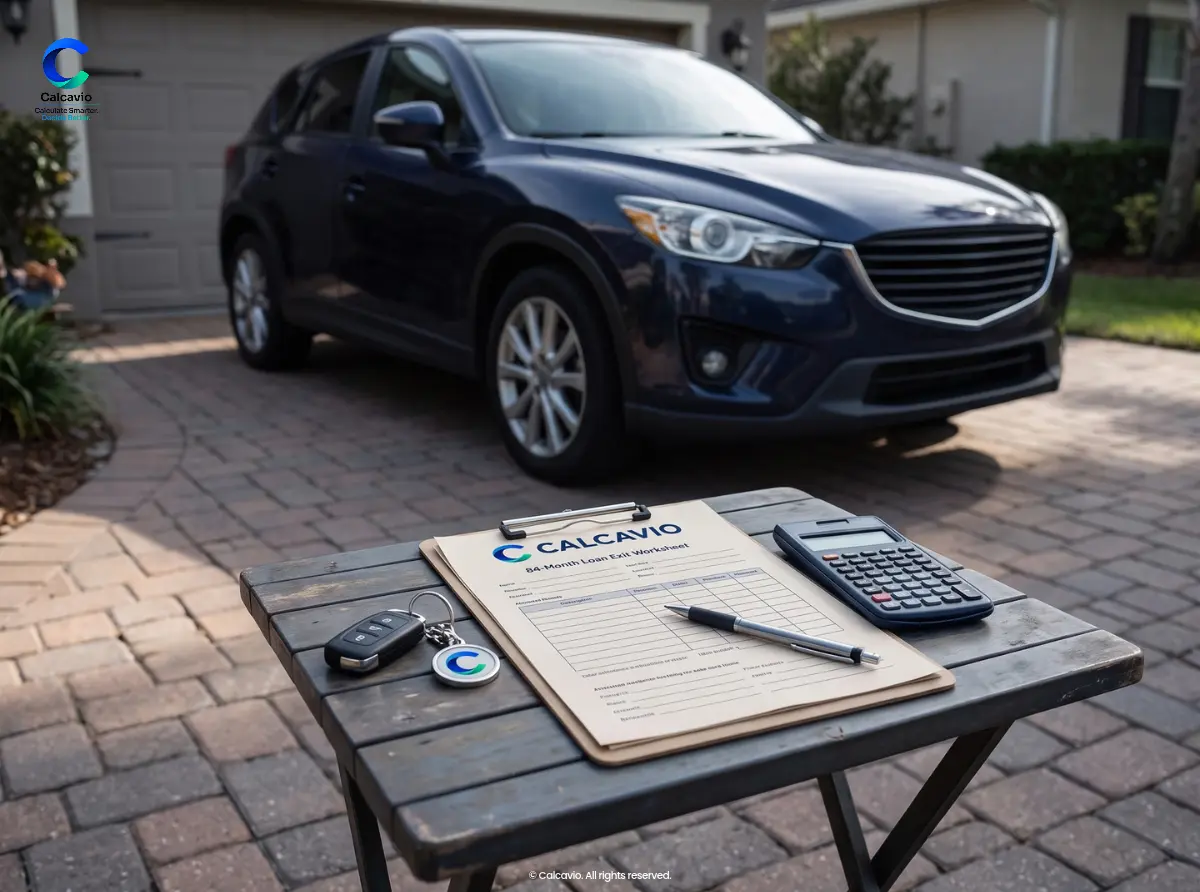
An 84-month car loan can fit your monthly budget yet leave a cash shortfall when you sell after three years. Before signing, compare the estimated balance after payment 36 with realistic sale proceeds. Then check whether your available cash could cover the difference, not just the monthly payment.
Cox Automotive’s October 13, 2026 report gives this test fresh context: loans longer than 72 months reached 31.8% of its September dataset. However, that is not an 84-month-only statistic or a forecast for your loan.
On this page: What changed · Balance after three years · Sale-offer scenarios · Exit worksheet · Verdict · FAQs
What changed in auto-loan terms?
Cox Automotive reported that loans longer than 72 months represented 31.8% of its September 2026 Dealertrack dataset, a dataset record. That category includes more than just 84-month contracts. The practical question is therefore not whether every long loan is risky, but whether sale proceeds would cover your dated payoff when you need to exit.
Longer financing spreads principal across more payments. Consequently, a manageable installment can coexist with substantial remaining debt. Start with the Car Loan Calculator to estimate that balance, then obtain transaction-specific figures before selling.
What will you owe on an 84-month car loan after three years?
Consider this illustrative scenario calculated October 22, 2026, not a current lending offer. Borrow $40,000 at a fixed 7% annual interest rate. Assume no down payment, trade-in, taxes, fees, extra payments or missed payments. Payments fall at month-end; monthly interest is 7% divided by 12. Because there are no fees, the assumed APR equals the note rate.
The 84-month car loan produces these derived results:
| Measure | 84-month scenario | Matched 60-month comparator |
|---|---|---|
| Amount borrowed | $40,000 | $40,000 |
| Annual rate | 7% | 7% |
| Monthly payment | $603.71 | $792.05 |
| Balance just after payment 36 | $25,210.93 | $17,690.47 |
To reproduce the math, let P = $40,000, r = 0.07 ÷ 12, n = the term, and M = the payment:
M = P × r ÷ [1 − (1 + r)^−n]

Balance after 36 payments = P × (1 + r)^36 − M × [(1 + r)^36 − 1] ÷ r
Calculations retain full precision internally and round only for display. However, actual cent-rounded payments and contract-specific interest accrual can change a payoff.
The 60-month version requires about $188.34 more each month. In return, it leaves $7,520.46 less scheduled debt at the same exit point. Nevertheless, that difference is not free cash or a complete ownership-cost comparison. Insurance, maintenance, fuel, taxes and depreciation remain separate.
For your 84-month car loan, enter your inputs in the calculator. Then read amortization row 36. The tool does not replace a lender’s payoff quote.
What if the sale offer is below payoff?
First, separate three figures: the buyer’s offer, your selling costs and the amount required to settle the loan. The CFPB explains that a payoff can differ from a statement balance because of interest or other charges. Therefore, request a payoff that remains valid through the expected settlement date.
For this 84-month car loan, assume a $22,000 sale immediately after payment 36:
Shortfall before sale costs = $25,210.93 − $22,000 = $3,210.93.
Next, add an illustrative $500 of seller-paid transaction costs. Net proceeds become $21,500, so the cash required rises to $3,710.93. If an offer is already net of those costs, do not subtract them again.
How much does the sale offer change the result?
Only the assumed offer changes below. Every row uses the same $25,210.93 scheduled balance and $500 sale costs. These are scenarios, not vehicle valuations or probabilities.
| Assumed gross offer | Net sale proceeds | Equity after costs | Cash needed to exit |
|---|---|---|---|
| $18,000 | $17,500 | −$7,710.93 | $7,710.93 |
| $22,000 | $21,500 | −$3,710.93 | $3,710.93 |
| $26,000 | $25,500 | $289.07 | $0 |
| $30,000 | $29,500 | $4,289.07 | $0 |
With these assumptions, the gross break-even offer is $25,710.93. Meanwhile, the matched 60-month loan would leave $3,809.53 positive equity at a $22,000 offer after $500 costs.
Use the Depreciation Calculator to explore resale assumptions. However, its rate-based estimate is not a guaranteed offer or VIN-level appraisal. Before transacting, replace assumptions with realistic written bids for the actual vehicle.
Which documents belong in your three-year exit worksheet?
For an 84-month car loan, keep the sale date, quote expiry and cash plan together. Otherwise, individually reasonable numbers may describe different dates.

| Worksheet field | Record or calculation |
|---|---|
| Planned sale and settlement dates | Your dates: ______; check when funds must arrive |
| Lender payoff quote | Amount: $______; requested on: ______ |
| Payoff valid-through date | [date]; daily interest after expiry: [USD/day], if applicable |
| Sale offers | Buyer/channel, written amount, conditions and expiry: ______ |
| Seller-paid costs | Itemized amounts not already deducted from the offer: $______ |
| Net sale proceeds | Gross offer minus seller-paid costs: $______ |
| Equity or shortfall | Net proceeds minus payoff: $______ |
| Cash required | Payoff plus seller-paid costs minus gross offer; minimum $0 |
| Cash available for this exit | $______; exclude money reserved for other obligations |
| Unfunded gap | Cash required minus available cash; minimum $0 |
| Settlement arrangements | Lender payment instructions, lien release/title process and timing |
Then follow three steps:
Steps to follow:
Then follow three steps:
- Estimate before borrowing.Test payment-36 debt against several sale assumptions for the 84-month car loan.
- Replace estimates before selling.Obtain a valid payoff and conditional written offers; confirm the lender’s settlement process.
- Check the funding gap.Identify accessible cash before committing to a transaction that needs it.
For example, $2,500 available cash against the $3,710.93 cost-adjusted shortfall leaves $1,210.93 unfunded. That is the difference between manageable monthly payments and sufficient exit cash.
Also, distinguish a trade-in allowance from cash sale proceeds. Record the old-loan payoff separately. If a dealer proposes adding negative equity to a replacement loan, show that new borrowing explicitly rather than treating the shortfall as erased. The CFPB warns that rolling debt forward can increase borrowing costs.
Calcavio’s Verdict

The verdict: An 84-month car loan needs a separate exit-cash check, not a blanket yes or no.
Best for: Readers planning a sale before the loan ends.
Skip this shortcut if: You need an exact settlement amount; obtain the lender’s quote instead.
Pros and cons
- Exposes cash shortfalls; compares one exit date; separates offers from forecasts.
- Future resale remains uncertain; estimates cannot settle a real loan.
Standout: Available cash, not just negative equity - determines the unfunded gap.
Also, compare budgets with the Auto Affordability Calculator. Keep monthly affordability and exit readiness separate.
Car Affordability Calculator: How Much Car Can I Afford?
Frequently asked questions
Will GAP insurance cover a voluntary-sale shortfall?+
Can I use APR directly in the balance formula?+
Will extra payments reduce what I owe after three years?+
Can I sell privately while there is a lien on the car?+
Would refinancing before year three make the car easier to sell?+
What should you check before choosing a term?
Finally, run the 84-month car loan through the Car Loan Calculator, record row 36, and complete the worksheet. A lower monthly bill answers one question; enough cash to settle the loan answers another.
Sources
- 72-month share, not 84-only; no correction surfaced in a bounded search — Cox Automotive (Published Oct 13, 2026; September 2026 observation)
- Secondary background, no reused quarterly statistics — CBT News (Oct 14, 2026)
- Excluded from fresh hook and no commercial charts copied — J.D. Power (April 16 / June 20 page date signals; March observations)
Run the numbers yourself
See your exact numbers in seconds — free, no signup.
Try the Car Loan CalculatorLatest Articles

Car Clearance Discount: 2026 vs. 2027 Break-Even Test
Compare a 2026 clearance price with a 2027 car’s financing and assumed resale value. This worksheet shows the discount needed to break even at the same sale date.

New vs Used Car Financing Break Even: Find Your Price
A lower used-car price can still mean higher loan repayments. Compare matched offers, find the used borrowing threshold, and check ownership costs separately.

Why Did My Fixed-Rate Mortgage Payment Increase This Year?
Your interest rate can stay fixed while your mortgage bill rises. Separate higher taxes and insurance from temporary escrow catch-up with a three-stage payment worksheet.