
Loans Calculators: All 14 Tools & Formulas for 2026
See the exact formula and a worked example behind all 14 Calcavio loan calculators and learn the one equation that powers almost every loan.
 Nathan Cole14 min read
Most borrowing mistakes don't happen at the bank. Instead, they happen at the kitchen table, weeks earlier, when someone guesses at a monthly payment rather than running it. In fact, U.S. household debt sits at a record $18.79 trillion as of the first quarter of 2026 and a big slice of that is loans people signed without ever seeing the true total cost. So loans calculators fix that. Basically, they turn a scary, jargon-filled decision into three or four numbers you can actually read.
This guide covers all 14 loans calculators on Calcavio, the exact formula behind each one, and a worked example you can check by hand. You'll see how a $15,000 personal loan, a $30,000 student loan, and a $150,000 SBA loan all trace back to the same short equation and how a two-week payday loan hides a triple-digit rate. By the end, you'll be able to sanity-check any lender's quote in under a minute. So bookmark it before your next application.
What is a loan calculator, and why does it matter?
A loan calculator is a tool that estimates what a loan will really cost you - the monthly payment, the total interest, and how long you'll be paying. First, you type in the amount, the interest rate, and the term. Then it returns the numbers a lender often buries in fine print. In short, loans calculators do the math so you don't have to guess.
So why does it matter? Because the difference between a good loan and a costly one is rarely the sticker rate. Instead, it's the total interest over time. For example, on a five-year loan, half a percentage point can quietly add hundreds of dollars. That's why running the math first is the cheapest financial habit you'll ever build and it takes about fifteen seconds.
The one formula behind almost every loan
Here's the part lenders don't advertise: most loans calculators are the same equation wearing different clothes. In fact, it's the amortizing-loan payment formula.
M = P · [ r(1 + r)ⁿ ] / [ (1 + r)ⁿ − 1 ]

P = principal (amount borrowed)
r = monthly interest rate (annual rate ÷ 12)
n = number of monthly payments (years × 12)
M = fixed monthly payment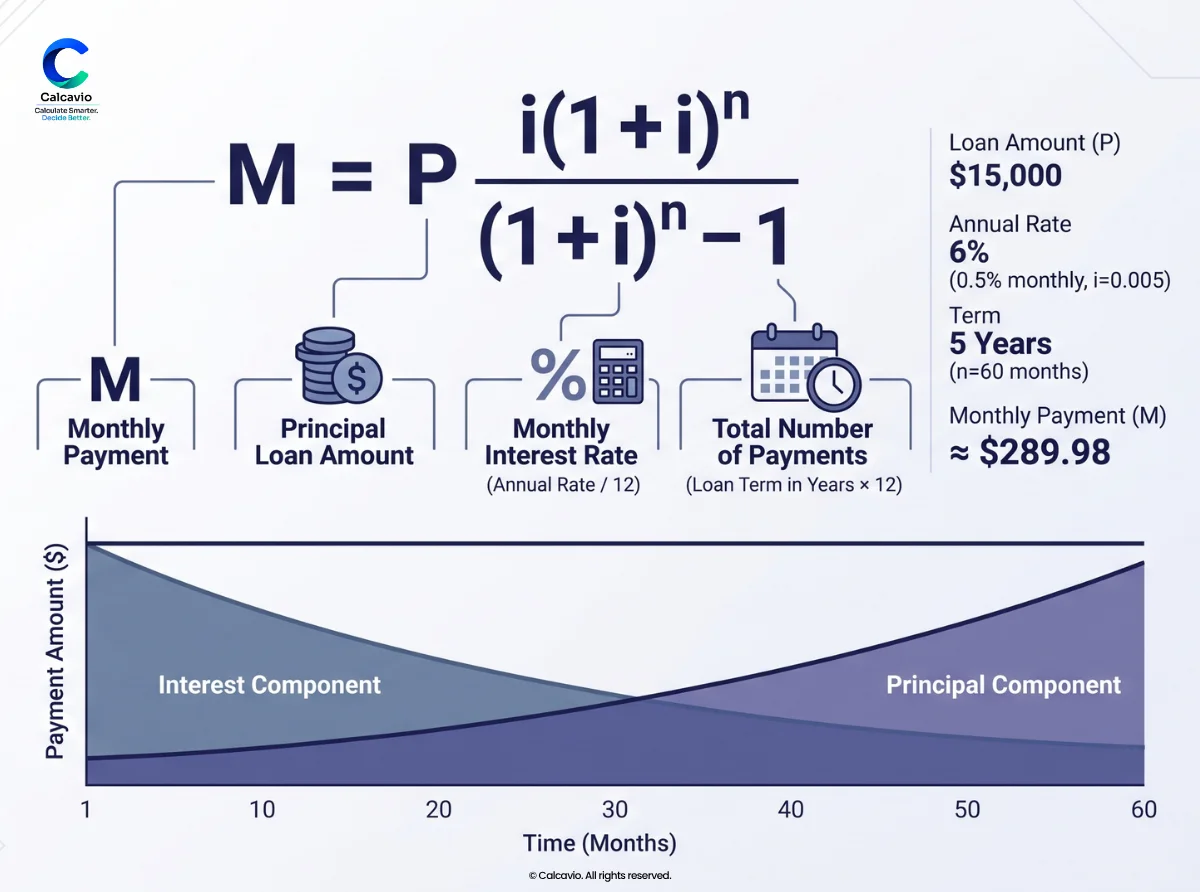
Now work a real example. Borrow $15,000 at a 12% APR for five years. So your monthly rate is 0.12 ÷ 12 = 0.01, and n = 60. Then plug it in, and the payment lands at about $334 a month - roughly $20,020 paid back in total, or about $5,020 in interest. Clearly, that single result tells you more than any brochure.
As you'll see, every loans calculator below is a variation on this theme. And once you spot the pattern, loans stop being mysterious.
How to use loans calculators in four steps
You don't need a finance degree to get a trustworthy answer. So follow these four steps, and any loans calculator on this page will give you a number you can act on.
- First enter the loan amount.Use the amount you actually plan to borrow, not the maximum you qualify for, because they're rarely the same.
- Second, enter the interest rate as an APR.Since APR includes fees, it's the honest number for comparison. If you only have the interest rate, then add estimated fees separately.
- Third, set the term in months or years.Shorter terms mean higher payments but far less total interest. So try two or three terms to see the trade-off.
- Finally, read total interest, not just the monthly payment.While the payment tells you what fits your budget, the total interest tells you what the loan truly costs.
For instance, run the same loan at two different terms, and the difference in total interest is often the most useful number on the screen.
Fixed vs. variable: which rate should you plug in?
Before you trust any result, know which kind of rate you're entering. A fixed rate stays the same for the life of the loan, so the calculator's payment is the payment you'll make every month - personal loans, most student loans, and auto loans usually work this way. By contrast, a variable rate moves with a benchmark like the Prime Rate, which sits at 6.75% in July 2026. For example, HELOCs and SBA 7(a) loans are common variable-rate products.
For variable loans, though, the calculator shows today's payment, not tomorrow's. So if the benchmark rises, your bill rises too. As a smart habit, run the loan at your current rate, then run it again two or three points higher to stress-test your budget. If the higher payment still works, then you've got breathing room. But if it doesn't, that's worth knowing before you sign, not after.
The 14 Calcavio loan calculators and the exact formula each one uses
Each of these loans calculators solves a specific borrowing question. Below, you'll find the formula, a quick worked example, and who it's built for. So start at the Loans Calculators hub and drill into whichever one fits your situation.
1. Personal Loan Calculator
M = P · [ r(1+r)ⁿ ] / [ (1+r)ⁿ − 1 ]The workhorse. For example, a $15,000 personal loan at 12% over 60 months costs about $334/month and roughly $5,020 in interest. Because average personal-loan APRs sit near 12.4% in mid-2026, you should shop your rate hard. So it's best for debt consolidation, big one-off expenses, or predictable fixed-payment borrowing. Run yours with the Personal Loan Calculator.
2. Student Loan Calculator
M = P · [ r(1+r)ⁿ ] / [ (1+r)ⁿ − 1 ]Again, the same amortization math, now applied to a fixed federal rate. For instance, a $30,000 balance at the 2026–27 federal undergraduate rate of 6.52% on a standard 10-year plan runs about $341/month and roughly $10,900 in interest. So it's best for students and parents estimating repayment before signing. Try the Student Loan Calculator.
3. Student Loan Payoff Calculator
n = − ln(1 − (r · B) / M) / ln(1 + r)Instead of payment, this one solves for time. For example, with a $30,000 balance at 6.52% and a $400 monthly payment, you'll clear it in about 97 months - just over eight years. Then bump the payment, and n drops fast. So it's best for borrowers who want a finish line, not just a minimum. Use the Student Loan Payoff Calculator.
Student Loan Payoff Calculator
4. Debt Consolidation Calculator
Weighted APR = Σ(balanceᵢ × APRᵢ) / Σ balanceᵢFirst it blends your existing rates, then it amortizes the new single loan. For instance, roll a $10,000 card at 22% and a $5,000 card at 19% into a $15,000 loan at 12% over four years: your blended old rate was 21%, while the new payment is about $395/month. So it's best for people juggling several high-rate balances. Compare with the Debt Consolidation Calculator.
5. Home Equity Loan Calculator
Available equity = (Home value × max LTV) − mortgage balanceThere are two steps: first find your borrowable equity, then amortize it. For example, on a $400,000 home at 85% LTV with a $250,000 mortgage, you can tap about $90,000. Then borrow that at 8% over 15 years, and you'll pay roughly $860/month. So it's best for large, planned projects backed by home value. Run it on the Home Equity Loan Calculator.
6. HELOC Calculator
Draw-period payment = Balance × (APR / 12)A HELOC has two phases. During the draw period, you often pay interest only: for example, a $50,000 balance at 8.5% costs about $354/month. Then, when repayment begins, the balance amortizes with the standard formula over the repayment term. So it's best for flexible, ongoing access to funds. Model both phases with the HELOC Calculator.
7. Loan Comparison Calculator
Total cost = (M × n) + feesThis tool exposes the trick rates hide. For example, Loan A is $20,000 at 11% with no fee ($26,094 total). Meanwhile, Loan B is $20,000 at 10% with a $600 origination fee ($26,099 total). So the "better" rate costs essentially the same once fees are in - which is exactly why you compare APR, not the headline number. So it's best for anyone weighing offers. Use the Loan Comparison Calculator.
8. Payday Loan Calculator
APR = (Fee ÷ Principal) ÷ Term in days × 365 × 100This is the scariest math on this page - on purpose. For example, a $400 payday loan with a $60 fee due in 14 days works out to a 391% APR. In fact, the CFPB pegs a typical two-week payday loan at close to 400%. So it's best used to talk yourself out of one. See the real cost on the Payday Loan Calculator.
9. SBA Loan Calculator
M = P · [ r(1+r)ⁿ ] / [ (1+r)ⁿ − 1 ]

(r = (Prime + margin) ÷ 12)
SBA 7(a) rates float on the Prime Rate (6.75% in July 2026) plus a lender margin. For example, a $150,000 loan at Prime + 2.75% (9.5%) over 10 years runs about $1,941/month. Meanwhile, SBA 7(a) maximums span roughly 9.75%–14.75%. So it's best for small-business owners financing growth. Estimate yours with the SBA Loan Calculator.
10. Loan Early Payoff Calculator
New n = − ln(1 − (r · B) / (M + extra)) / ln(1 + r)Add to your payment, and then watch the term shrink. For example, on a $20,000 loan at 7% over 60 months (about $396/month), throwing in an extra $100 a month clears it in roughly 46 months and saves around $900 in interest. So it's best for anyone with spare cash flow. Test scenarios on the Loan Early Payoff Calculator.
11. Student Loan Refinance Calculator
Savings = (Old M × n) − (New M × n)Here you compare your current loan against a new rate. For instance, refinance $40,000 with 8 years left from 7.5% down to 5.5% and the payment falls from about $555 to $516 - roughly $3,775 saved over the term. However, one caveat matters: refinancing federal loans into a private loan forfeits federal protections like income-driven plans and forgiveness. So it's best for high-rate private-loan holders. Weigh it on the Student Loan Refinance Calculator.
Student Loan Refinance Calculator
12. Boat Loan Calculator
M = P · [ r(1+r)ⁿ ] / [ (1+r)ⁿ − 1 ]Recreational loans stretch longer, which lowers the payment but raises total interest. For example, a $50,000 boat loan at 8% over 15 years costs about $478/month - but roughly $36,000 in interest across the term. So it's best for buyers eyeing a longer amortization. Run the numbers on the Boat Loan Calculator.
13. TVM Payment Calculator
PMT = r · (PV(1+r)ⁿ + FV) / [ (1+r)ⁿ − 1 ]This is the grandparent of every formula here. Basically, this general time-value-of-money equation handles any present value (PV) and future value (FV). So set FV to zero, and it collapses back into the standard loan payment. For example, a $25,000 present value at 6% over 48 months (FV = 0) yields a $587/month payment. So it's best for finance students and anyone modeling leases or annuities. Explore it on the TVM Payment Calculator.
14. Loan Repayment Calculator
Total repayment = M × n · Total interest = (M × n) − PFinally, the plain-English summary tool. For example, borrow $12,000 at 9% over three years and your payment is about $382/month - $13,737 repaid, with $1,737 of that being interest. So it's best for a fast, honest total on any fixed loan. Get your figure from the Loan Repayment Calculator.
How to pick the right loan calculator
Not sure where to start? Simply match your question to the right loans calculator below.
| Your question | Use this calculator |
|---|---|
| "What's my monthly payment?" | Personal Loan / Loan Repayment |
| "When will I be debt-free?" | Student Loan Payoff / Loan Early Payoff |
| "Which offer is actually cheaper?" | Loan Comparison |
| "Should I combine my debts?" | Debt Consolidation |
| "How much can I borrow against my home?" | Home Equity Loan / HELOC |
| "Can I do better than my current rate?" | Student Loan Refinance |
| "What will this cost my business?" | SBA Loan |
The mistakes that quietly cost borrowers thousands
Here's what most loan guides skip. Surprisingly, the number that wrecks budgets isn't the interest rate - it's the term. Because you're paying that rate for longer, stretching a loan an extra two years shaves the monthly payment but can add thousands in interest. For example, the boat-loan example above proves it: a comfortable $478 a month still hides $36,000 in total interest.
Second trap: comparing rates instead of APR. Fees, points, and origination charges don't show up in the interest rate - instead, they show up in APR. As the Loan Comparison example showed, a "lower" rate with a fee can cost the same as a higher rate without one.
Third: ignoring the payoff lever. A modest extra payment each month is the highest-return move most borrowers never make. Besides, it's tax-free, risk-free, and guaranteed. So run it once, and you'll rarely go back.
Fourth, and most common: budgeting to the monthly payment alone. Lenders love this, because a low payment feels affordable even when the total cost is brutal. The payment is only half the story; meanwhile, the total interest is the other half, and it's the half that decides whether a loan was smart.
So what's the honest takeaway? A calculator can't stop you from overborrowing but it removes every excuse for being surprised.
Calcavio's Verdict
The verdict: Loans calculators are the single most useful free tool a borrower can use before signing anything and skipping them is how good people end up in expensive loans.
Best for: Anyone comparing offers, planning a payoff, or estimating what they can truly afford.
Skip it if: You've already run the exact loan with the exact rate and term elsewhere.
Pros and cons
- Instant total-cost clarity
- Reveals APR traps and term traps
- Works across every loan type on one formula
- Results are estimates, not offers
- Garbage inputs give garbage answers
Standout: Almost all 14 tools run on the same amortization equation - so learn it once, and you can sanity-check any lender's quote by hand, which is something no loan brochure will ever teach you.
Frequently asked questions
How accurate are online loan calculators?+
What's the difference between interest rate and APR?+
Should I refinance my student loans?+
How can I pay off a loan faster without refinancing?+
Why is a payday loan's APR so high?+
Does using a loan calculator affect my credit score?+
How much of my income should go toward loan payments?+
The bottom line

Ultimately, loans calculators don't just crunch numbers - they hand you the leverage. So whether you're comparing two offers, planning an early payoff, or sizing up a home-equity loan, the same amortization formula gives you a total cost you can trust before you ever sign. That's the whole point of Calcavio: calculate smarter, decide better.
In practice, pick the loans calculator that matches your question, run your real numbers, and let the math make the call. Ready to see your true cost? Start free at the Loans Calculators hub - no signup, no formula memorizing required.
Drop it in the comments.
⚠️
Sources
- Consumer Financial Protection Bureau - What is a payday loan? — typical payday APR near 400%.
- Federal Reserve Bank of New York - Household Debt and Credit Report, Q1 2026 — $18.79 trillion in total U.S. household debt.
- Federal Student Aid, U.S. Department of Education - Interest Rates for New Direct Loans — 2026–27 undergraduate rate of 6.52%.
- U.S. Small Business Administration - 7(a) loan terms and rates — SBA 7(a) rate caps.
- Household Debt and Credit Report, Q1 2026 ($18.79T): — Federal Reserve Bank of New York
- Best Personal Loan Rates, July 2026 (avg ~12.4% APR): — Bankrate
- Interest Rates for New Direct Loans, 2026–27 (6.52% undergraduate): — Federal Student Aid (U.S. Dept. of Education)
- What is a payday loan? (~400% APR): — Consumer Financial Protection Bureau
- How Payday Loans Work: Example of 391% APR: — Federal Reserve Bank of St. Louis
- 7(a) loan terms & rates (Prime 6.75%; max 9.75–14.75%): — U.S. Small Business Administration
- U.S. Student Loan Debt Statistics ($1.87T, Q1 2026): — LendingTree
Run the numbers yourself
See your exact numbers in seconds — free, no signup.
Try the Personal Loan CalculatorLatest Articles
Tax Calculators: Every Formula Behind All 25 Tools (2026)
Every tax calculator on Calcavio, explained with its exact 2026 formula - from US federal brackets to UK VAT, Canadian rates, and Australian GST.
Savings Calculators: All 11 Formulas Explained
Every Calcavio savings calculator explained - 11 tools, 11 formulas, 11 worked examples, from savings goals and CD ladders to 529 college plans.

Personal Finance Calculators: All 15 Formulas Explained
Every Calcavio personal finance calculator explained - 15 tools, 15 formulas, 15 worked examples, from the 50/30/20 budget to your FI number.