
Auto Calculators: Every Vehicle Formula, Explained
Fourteen auto and vehicle calculators, the exact formula behind each one, and a worked example you can check by hand before you sign anything.
 Nathan Cole
Auto calculators turn a car deal into a number you can actually check. And you need that, because the average American now pays $770 a month for a new car. Granted, that is not for a luxury SUV rather, it is the average new vehicle, financed over nearly six years, according to Experian's Q1 2026 State of the Automotive Finance Market Report. In fact, more than a third of those loans now stretch past 72 months, simply because that is the only way the payment fits.
Still, here's the part that should bother you. Almost nobody runs the numbers before walking into a dealership. Instead, they negotiate the sticker price and then accept whatever payment the finance office prints. Meanwhile, the finance office is very good at making a bad deal look like a good payment.
So auto calculators fix that. Specifically, not the vague ones that spit out a payment with no explanation, but the fourteen auto and vehicle calculators that answer every question a car costs you. Namely: what you'll pay monthly, whether leasing beats buying, what you can actually afford, and what fuel, tires and depreciation quietly take on top. Below, therefore, you'll find all fourteen the real formula for each, plus a worked example you can check by hand.
Ultimately, run them before you sign. That, in short, is the whole trick.
What are auto calculators?
Every one of them is just arithmetic. The reason people don't do it by hand isn't difficulty it's that the amortization formula has an exponent in it, and nobody wants to raise 1.0054 to the 60th power in a dealership parking lot. So the formula sits in the calculator, and you get the answer in three seconds.
But you should still know what the formula is. When you know the shape of the math, you can tell instantly whether a dealer's offer makes sense and you can spot the two moves that hide the most money: stretching the term and quoting the payment instead of the price.
Start with our free auto loan calculator if you just want the payment. Read on if you want to understand what it's doing.
The 14 auto calculators at a glance
| # | Calculator | Answers | Core formula |
|---|---|---|---|
| 1 | Car Loan | Monthly payment + total interest | Amortization |
| 2 | Lease vs. Buy | Which is cheaper over your horizon | Total cost of ownership |
| 3 | Auto Refinance | Whether a new rate saves money | Balance + re-amortize |
| 4 | Car Affordability | The price you can actually carry | 20/4/10 + reverse amortization |
| 5 | Rebate vs. Low Interest | Cash back or cheap money | Compare two totals |
| 6 | Truck Loan | Payment on heavier borrowing | Amortization |
| 7 | Motorcycle Loan | Payment on a short-term loan | Amortization |
| 8 | RV Loan | Payment on a 15–20 year term | Amortization |
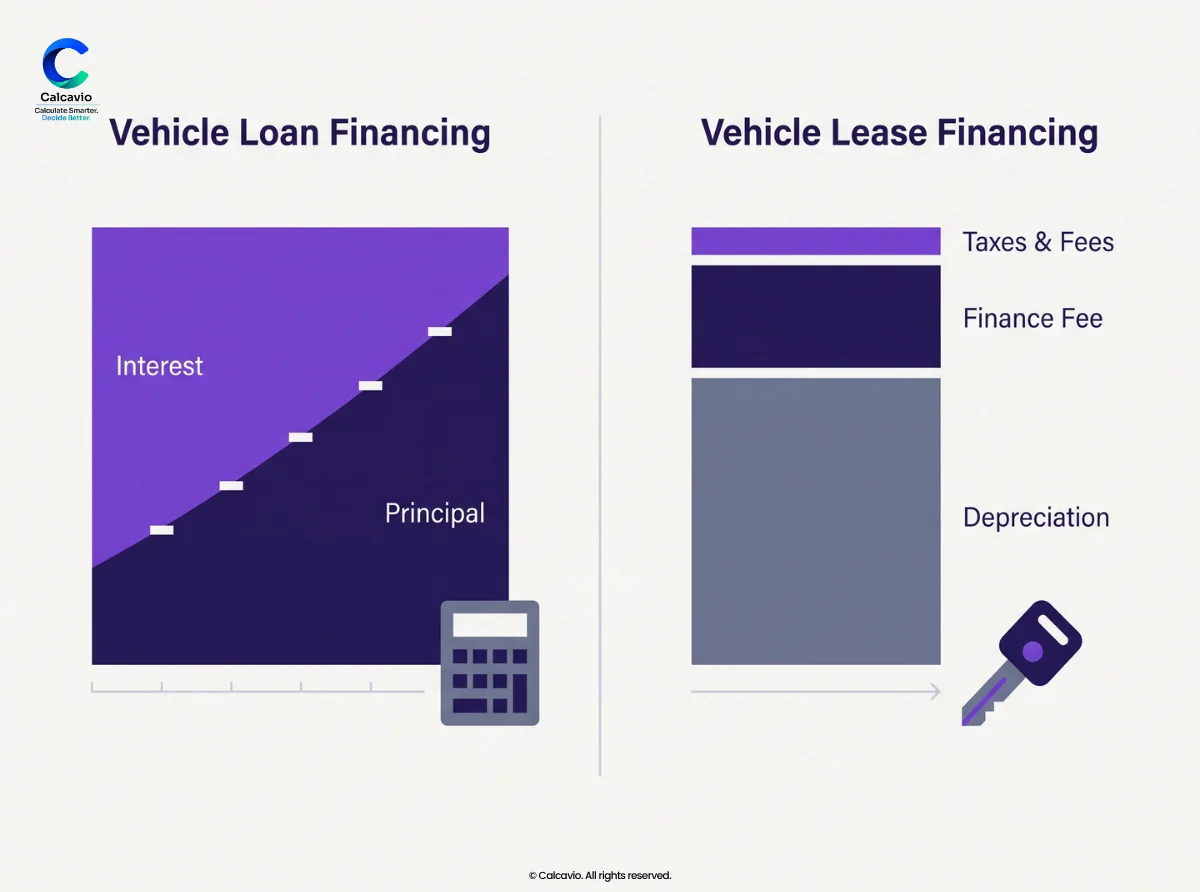
| 9 | Auto Lease | Payment from residual + money factor | Depreciation + finance fee |
| 10 | MPG / Gas Mileage | True fuel economy | Miles ÷ gallons |
| 11 | Fuel Cost | Annual or per-trip fuel spend | Miles ÷ MPG × price |
| 12 | Tire Size | Diameter, sidewall, speedo error | Sidewall + rim geometry |
| 13 | Horsepower | Power from torque, ET, or trap speed | Torque × RPM ÷ 5,252 |
| 14 | Car Depreciation | What it'll be worth later | Declining residual |
Financing auto calculators: what the loan actually costs
As noted above, nine of the fourteen answer money questions and eight of those nine run on a single formula. Learn it once, and you've learned most of car finance.
1. Car Loan Calculator
M = P × [ r(1 + r)^n ] ÷ [ (1 + r)^n − 1 ]

M = monthly payment   P = amount financed
r = APR ÷ 12          n = term in months
Worked example. Finance $35,000 at 6.5% over 60 months. r = 0.0054167, n = 60.
Monthly payment = $684.82. Total repaid $41,088.91, of which $6,088.91 is interest.
Stretch the same loan to 72 months and the payment drops to $588.35 - a relief of $96 a month. Total interest climbs to $7,361.02. You paid $1,272 for that relief. That's the trade Experian is measuring when it reports that 35.55% of new loans now run past six years.
👉 Use our free Car Loan Calculator - no formula needed.
2. Car Lease vs. Buy Calculator
Lease cost  = (monthly lease payment × term) + drive-off costs + expected end fees
Buy cost    = (monthly payment × term) − equity at term end
Equity      = resale value − remaining loan balance
Worked example. A $45,000 crossover, three-year horizon.
- Lease: 55% residual, 0.00225 money factor, 36 months → $719.44/month → $25,899.75 total.
- Buy: $45,000 at 6.5% over 60 months → $880.48/month. Thirty-six payments = $31,697.16. Loan balance after 36 months = $19,765.45. At KBB's 61% three-year residual the car is worth $27,450, so your equity is $7,684.55.
- Net cost of buying = $24,012.61.
Buying wins by $1,887 over three years but only because you keep the equity. Sell into a soft market and that gap closes fast. Edmunds puts three-year retention at just 66% of MSRP in Q1 2026, a five-year low, which is exactly the risk leasing hands back to the dealer.
👉 Compare both in our Lease vs. Buy Calculator.
3. Auto Refinance Calculator
Step 1  Current balance  B = P(1+r)^k − M × [ ((1+r)^k − 1) ÷ r ]
Step 2  New payment      re-amortize B at the new rate and remaining term
Step 3  Savings          (old payment × months left) − (new payment × months left)
Worked example. You borrowed $32,000 at 11.4% over 72 months - $615.67 a month. Two years in, your balance is $23,642.93. Your credit has improved and you qualify for 7.4% over the remaining 48 months.
New payment: $570.56. You save $45.11 a month and $2,165.25 in interest - without extending the term. That last clause matters: most "savings" quotes come from restarting the clock.
Experian found refinancing trimmed an average of 2.2 percentage points off rates in Q1 2026, worth about $81 a month.
👉 Check your break-even with the Auto Refinance Calculator.
4. Car Affordability Calculator
20% down · 4-year maximum term · total vehicle cost ≤ 10% of gross monthly income

Max payment  = gross monthly income × 0.10 − (insurance + fuel + maintenance)
Max financed = payment × [ (1+r)^n − 1 ] ÷ [ r(1+r)^n ]
Max price    = max financed ÷ 0.80
Worked example. Gross income $6,000 a month. Ten percent = $600. Subtract $160 for insurance and you have $440 for the loan.
At 6.5% over 48 months, $440 finances $18,553.69. Add the 20% down payment and your honest ceiling is a $23,192 car.
That's less than half the $49,758 average transaction price Kelley Blue Book recorded in June 2026. Which tells you something uncomfortable about how the average car is being bought.
👉 Find your real ceiling with the Car Affordability Calculator.
5. Rebate vs. Low Interest Calculator
Option A total = amortize (price − rebate) at the standard APR
Option B total = amortize (price) at the promotional APR
Choose the smaller total — never the smaller payment
Worked example. A $35,000 car. Take a $3,000 rebate and finance $32,000 at 6.5%, or take 1.9% APR on the full $35,000. Sixty months either way.
- Rebate: $626.12/month → $37,567.00 total
- Low interest: $611.94/month → $36,716.50 total
Low interest wins by $850.50. Flip the term to 36 months and the rebate usually wins instead, because there's less interest for the cheap rate to save. There's no universal answer - only the two totals.
👉 Run both offers side by side.
Rebate vs. Low Interest Calculator
6. Truck Loan Calculator
Formula: same amortization as a car loan - the variables are what differ. Full-size trucks carry higher principals, and lenders push 84-month terms to keep the payment presentable.
Worked example. $62,000 at 7.25%.
| Term | Payment | Total interest |
|---|---|---|
| 72 months | $1,064.50 | $14,643.78 |
| 84 months | $943.34 | $17,240.68 |
The 84-month version saves $121 a month and costs $2,596.90 more. Worse, you're underwater longer: a truck depreciating on the standard curve won't clear an 84-month balance until roughly year five.
👉 Price your build with the Truck Loan Calculator.
7. Motorcycle Loan Calculator
Formula: identical amortization, but powersports lending runs at higher APRs and shorter terms than auto lending.
Worked example. $14,000 at 8.99%.
- 48 months → $348.32/month, $2,719.56 interest
- 60 months → $290.55/month, $3,432.94 interest
A year of extra term costs $713 here. On a bike you may ride seasonally, run the math on cost per riding month, not cost per calendar month - six months of storage still bills you.
👉 Use the Motorcycle Loan Calculator.
8. RV Loan Calculator
Formula: same amortization stretched across mortgage-length terms - 120 to 240 months is normal.
Worked example. $95,000 at 7.99%.
| Term | Payment | Total interest |
|---|---|---|
| 15 years (180 mo) | $907.32 | $68,317.80 |
| 20 years (240 mo) | $794.03 | $95,566.46 |
Five more years costs $27,248 in extra interest to save $113 a month. On an asset that depreciates faster than a car, that's the single most expensive checkbox in the RV finance office.
👉 Model the term with the RV Loan Calculator.
9. Auto Lease Calculator
Residual        = MSRP × residual %
Depreciation fee = (capitalized cost − residual) ÷ term
Finance fee      = (capitalized cost + residual) × money factor
Monthly payment  = depreciation fee + finance fee
Equivalent APR   = money factor × 2,400
Worked example. Cap cost $45,000, 55% residual, money factor 0.00225, 36 months.
- Residual = $24,750
- Depreciation fee = ($45,000 − $24,750) ÷ 36 = $562.50
- Finance fee = ($45,000 + $24,750) × 0.00225 = $156.94
- Monthly payment = $719.44 and that money factor is a 5.4% APR
The money factor is where leases hide their margin, because 0.00225 doesn't look like a rate. Multiply by 2,400, always. For reference, Experian put the average lease payment at $619 in Q1 2026.
👉 Break down any lease offer.
Running-cost auto calculators: what the car costs after you buy it
The payment is the number people negotiate. Meanwhile, these five auto calculators decide what the car actually costs you and depreciation, quietly, is almost always the biggest line item of all.
10. MPG / Gas Mileage Calculator
MPG        = miles driven ÷ gallons used
L/100 km   = 235.215 ÷ MPG
Worked example. Fill up, zero the trip meter, drive, refill. You covered 412 miles and took 13.4 gallons: 412 ÷ 13.4 = 30.7 MPG. In metric, a 30.8 MPG rating is 7.64 L/100 km.
Measure across two or three tanks. One tank tells you about one week of traffic, not about your car.
👉 Use the MPG / Gas Mileage Calculator.
11. Fuel Cost Calculator
Fuel cost = (miles ÷ MPG) × price per gallonWorked example. 13,500 miles a year, 30.8 MPG, $3.15 a gallon → $1,380.68 a year.
Swap to a 22 MPG SUV on the same miles and it's $1,932.95 - $552 more each year, or about $2,761 across a five-year hold. That difference belongs in your lease-vs-buy comparison, and almost never appears in one.
👉 Estimate your Annual Spend.
12. Tire Size Calculator
Sidewall height (mm) = section width × (aspect ratio ÷ 100)
Overall diameter     = (rim inches × 25.4) + (2 × sidewall height)
Speedometer error %  = (new diameter − old diameter) ÷ old diameter × 100
Worked example. Stock 225/65R17: sidewall 146.25 mm, diameter 724.3 mm (28.52 in). Upgrade to 235/60R18: sidewall 141 mm, diameter 739.2 mm (29.10 in).
That's +2.06%. Your speedometer now reads 60 when you're doing 61.2 mph, and your odometer under-counts by the same 2%. Stay within ±3% and you're inside the tolerance most manufacturers design for.
👉 Compare sizes with the Tire Size Calculator.
13. Horsepower Calculator
HP (from torque)     = torque (lb-ft) × RPM ÷ 5,252
HP (ET method)       = weight ÷ (ET ÷ 5.825)³
HP (trap speed)      = weight × (trap MPH ÷ 234)³
kW                   = HP × 0.7457
Worked example. 295 lb-ft at 5,200 rpm → 295 × 5,200 ÷ 5,252 = 292.1 hp (217.8 kW).
The same car weighing 3,800 lb runs a 13.4-second quarter mile at 104 mph. ET method: 312 hp. Trap method: 334 hp. The three disagree because torque math measures the engine while the track measures the whole car - traction, gearing, and driver included.
👉 Convert Torque, ET, or Trap speed.
14. Car Depreciation Calculator
Value after n years = purchase price × (1 − d₁)(1 − d₂)…(1 − dₙ)

KBB 2026 curve: year 1 −16% · year 2 −12% · year 3 −11% · year 4 −9% · year 5 −7%
Worked example. Buy at the June 2026 average transaction price of $49,758:
| End of year | Residual | Value |
|---|---|---|
| 1 | 84% | $41,797 |
| 2 | 72% | $35,826 |
| 3 | 61% | $30,352 |
| 4 | 52% | $25,874 |
| 5 | 45% | $22,391 |
Five-year depreciation: $27,367 - roughly $456 a month, evaporating whether you drive the car or not. Compare that to the $6,089 of interest on our first example loan. Depreciation is the real cost of a new car; interest is a rounding error beside it.
👉 Project Resale Value.

The Five-Number Car Check: how to use these auto calculators together
Fourteen calculators is a lot to face down before a Saturday test drive. In practice, a car purchase only turns on five numbers and the order you run them in matters more than the tools themselves.
- Your ceiling.Run affordability first, before you look at a single listing. It's the only number that comes from your life instead of the dealer's inventory.
- Your payment.Take the ceiling into the loan calculator at a realistic APR and the shortest term you can stand. If the car you want needs 84 months to fit, it doesn't fit.
- Your structure.Lease vs. buy, then rebate vs. low interest. Two comparisons, four totals, one winner.
- Your running cost.Fuel cost plus insurance, added to the payment. This is the number that actually leaves your account each month.
- Your exit.Depreciation. What's it worth in three or five years, and will you have equity or a balance?
Calcavio's Verdict
The Verdict: Run the affordability and depreciation numbers before you ever discuss a monthly payment those two calculators change more outcomes than the other twelve combined.
Best for: Anyone financing or leasing in 2026, when the average new payment is $770 and a third of loans run past six years.
Skip it if: You're paying cash for a used car under $10,000 - check the tire and MPG math and move on.
Pros and cons
- Every formula here is plain arithmetic you can verify
- The numbers expose the two levers dealers lean on (term length and money factor)
- Running all five checks takes under ten minutes
- garbage inputs produce confident garbage outputs - a guessed APR ruins the whole model
- None of it accounts for a genuinely bad car, and no calculator inspects a used vehicle for you
Standout:
Frequently asked questions
What is the formula for a car loan payment?+
Is it cheaper to lease or buy a car in 2026?+
How much car can I afford on a $60,000 salary?+
What is a money factor and how do I convert it to an APR?+
When does refinancing an auto loan actually make sense?+
How fast does a new car depreciate?+
Do bigger tires affect my speedometer reading?+
Conclusion
Car buying isn't hard math. It's just math that nobody does at the moment it matters most — standing in a finance office, tired, at the end of a long Saturday.
Three things are worth remembering. Term length is where payments get cheap and cars get expensive. Money factor is where lease margin hides. And depreciation, not interest, is the largest cost of owning a new vehicle. Any auto and vehicle calculator on this page will show you all three in under a minute.
So run your numbers before the test drive, not after. Start with the Car Affordability Calculator - it's free, and it's the one number the dealership will never give you.
Which number surprised you most - the 84-month interest total, or the $456 a month in depreciation? Tell us in the comments.
Required YMYL disclaimer
Sources
- State of the Automotive Finance Market Report, Q1 2026 — Experian
- New Experian Automotive report shows nearly one-third of automotive loan terms are longer than six years (28 May 2026) — Experian plc
- Average Car Payment and Auto Loan Statistics: 2026 (June 2026, citing Experian Q1 2026) — LendingTree
- June 2026 Average Transaction Price Report — Kelley Blue Book / Cox Automotive
- Car Depreciation Calculator and average depreciation curve — Kelley Blue Book
- Q1 2026 Used Car Report: three-year residual values hit a five-year low — Edmunds
- FuelEconomy.gov (fuel-economy methodology) — U.S. Department of Energy / EPA
- Auto loans guidance (YMYL authority link) — Consumer Financial Protection Bureau
Run the numbers yourself
See your exact numbers in seconds — free, no signup.
Try the Car Loan CalculatorLatest Articles
Tax Calculators: Every Formula Behind All 25 Tools (2026)
Every tax calculator on Calcavio, explained with its exact 2026 formula - from US federal brackets to UK VAT, Canadian rates, and Australian GST.

Savings Calculators: All 11 Formulas Explained
Every Calcavio savings calculator explained - 11 tools, 11 formulas, 11 worked examples, from savings goals and CD ladders to 529 college plans.

Personal Finance Calculators: All 15 Formulas Explained
Every Calcavio personal finance calculator explained - 15 tools, 15 formulas, 15 worked examples, from the 50/30/20 budget to your FI number.