
How Much Are Closing Costs? How to Estimate Them on Any Home
Closing costs usually run 2%--5% of the price. Here's what's inside the bill, a 3-bucket way to estimate it on any home, and where to check it on your Loan Estimate.
 Nathan Cole

Your offer just got accepted. Then your agent says, "Budget 10% for closing costs." On a $220,000 house, that's $22,000 you didn't plan for. Panic? Probably not. How much are closing costs?
So how much are closing costs, really? For most US buyers, they land between 2% and 5% of the purchase price, the range Zillow and Fannie Mae publish. A "10%" quote usually mixes in your down payment or the seller's commission. Below, you'll see what's inside the bill, how to estimate it on any home price, and where to check it on your Loan Estimate.
Want a number right now? Plug your price and loan into our free Closing Cost Calculator, then read on to see what drives it.
How much are closing costs?
Closing costs are the one-time fees and prepaid expenses you pay to get a mortgage and take ownership of a home. For most buyers, they total about 2% to 5% of the purchase price, paid at closing on top of the down payment. Your exact figure depends on your loan, your state's taxes, and your prepaid escrow.
The Consumer Financial Protection Bureau (CFPB) also calls them "settlement costs." Either way, the label covers two kinds of money. Some pays for services, like the appraisal and title search. The rest is your own housing bills paid early, such as a year of homeowners insurance. Because prepaids can be a third of the total, two buyers with the same lender can see very different bills.
Why do closing cost estimates range from 1% to 10%?
Closing cost estimates range from 1% to 10% because each source counts different items. A 1% figure usually covers only title, settlement, recording, and transfer taxes. A 2%–5% estimate adds lender charges and prepaids. A 10% figure usually adds a down payment or a seller's commission, which aren't buyer closing costs.
Here's what each number actually measures:
| The number you heard | What it usually includes | What it leaves out |
|---|---|---|
| About 1% (LodeStar's 1.04% average) | Title policies, settlement fees, recording fees, transfer taxes | Lender fees, prepaids, escrow deposits |
| 2%–5% (Zillow, Fannie Mae, Redfin) | Lender fees, third-party services, title, taxes, prepaids | Your down payment |
| About 6%–10% | Seller costs (commissions, repairs, credits) or a buyer's cash to close | It's a different bill |
The "10%" scare keeps resurfacing on Reddit. In one r/FirstTimeHomeBuyer thread, an agent quoted 10% on a $220,000 house. The 3-bucket method below puts that home's closing costs near $7,262 (3.3%). Add a 10% down payment, though, and cash to close hits about $29,262. That's likely where the 10% came from.
So whenever you hear a percentage, ask: "What does that include?"
What's included in closing costs?
Closing costs include lender charges, third-party services, title insurance, government fees, and prepaid items. The CFPB lists appraisal fees, tax service fees, title insurance, government taxes, and prepaid expenses as common charges. Your Loan Estimate groups them into lettered sections.
| # | Loan Estimate section | Common line items | Can you shop for it? |
|---|---|---|---|
| A | Origination Charges | Application, underwriting, and processing fees, plus any points | No, but compare lenders |
| B | Services You Cannot Shop For | Appraisal, credit report, flood certification, tax service | No |
| C | Services You Can Shop For | Title search, lender's title policy, settlement agent, survey, pest inspection | Yes |
| E | Taxes and Other Government Fees | Recording fees, transfer taxes | No |
| F | Prepaids | Homeowners insurance (often 6–12 months), prepaid daily interest, any prepaid property tax | Insurance, yes |
| G | Initial Escrow Payment | A cushion of property tax and insurance for your escrow account | No |
| H | Other | Owner's title policy (often optional), HOA transfer fees, home inspection | Often |
How do you estimate closing costs on any home price?
You can estimate closing costs on any home price by adding three buckets: lender charges, title and government fees, and prepaids and escrow. Lender charges scale with the loan, title fees scale with the price, and prepaids follow your tax and insurance bills. Together, they usually land near 3% of the price.
Here's the formula Calcavio uses:
Closing costs = (origination % × loan) + required services + (title % × price) + recording and transfer taxes + prepaids + escrow depositStep by step
- Find your loan amount.Subtract your down payment from the price.
- Estimate lender charges.Use about 1% of the loan, plus roughly $750 for the appraisal and other required services.
- Estimate title and settlement.Use about 0.7% of the price.
- Add government fees.Use about $300 for recording, plus any transfer tax buyers pay locally.
- Add prepaids.Include 12 months of homeowners insurance and about 15 days of interest.
- Add the escrow deposit.Try three months of property tax and two of insurance.
Worked example: a $300,000 home
Say you're buying a $300,000 home with 10% down at 7.40%, Freddie Mac's 30-year average for the week of October 8, 2026. Assume property tax of 1% a year and insurance of $1,800 a year.
- Loan = $300,000 − $30,000 = $270,000
- Lender charges = 1% × $270,000 + $750 = $3,450
- Title and government = 0.7% × $300,000 + $300 = $2,400
- Prepaid interest = $270,000 × 7.40% ÷ 365 × 15 days = $821.10
- Prepaids and escrow = $1,800 insurance + $821.10 interest + $750 tax (3 months) + $300 insurance (2 months) = $3,671.10
- Total = $3,450 + $2,400 + $3,671.10 = $9,521.10, or 3.2% of the price
Your cash to close, then, is about $39,521, before earnest money or seller credits. Notice that prepaids and escrow form the largest bucket. That's why "fees" alone look deceptively small.
Skip the math.
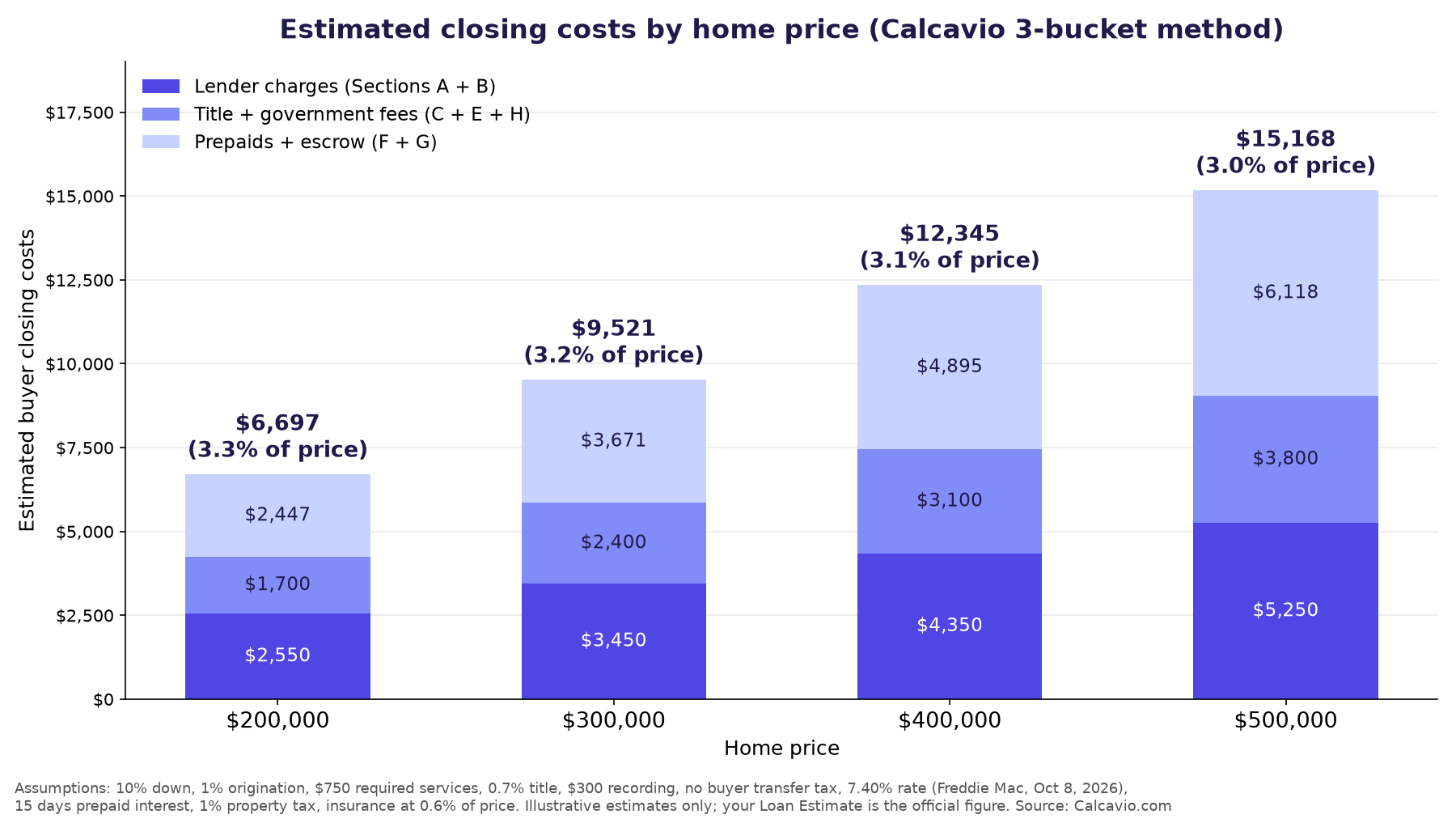
How much are closing costs on a $200k, $300k, $400k, or $500k house?
Closing costs on a $200,000 to $500,000 house typically run about $6,700 to $15,200 under Calcavio's 3-bucket assumptions, or roughly 3% to 3.3% of the price. The broad 2%–5% rule gives a wider range, from $4,000 on a $200,000 home to $25,000 on a $500,000 home.
The table uses the worked example's assumptions (insurance at 0.6% of price, no buyer transfer tax), rounded to the nearest dollar.
| Home price | Lender charges | Title + government | Prepaids + escrow | Estimated total (% of price) | 2%–5% rule range |
|---|---|---|---|---|---|
| $200,000 | $2,550 | $1,700 | $2,447 | $6,697 (3.3%) | $4,000–$10,000 |
| $300,000 | $3,450 | $2,400 | $3,671 | $9,521 (3.2%) | $6,000–$15,000 |
| $400,000 | $4,350 | $3,100 | $4,895 | $12,345 (3.1%) | $8,000–$20,000 |
| $500,000 | $5,250 | $3,800 | $6,118 | $15,168 (3.0%) | $10,000–$25,000 |
Percentages shrink slightly as prices rise, because fixed fees get spread thinner. High transfer-tax states break the pattern, though. LodeStar found Delaware averaging 3.06% of the price in fees alone.
Still saving up? The Down Payment Savings Calculator can fold this closing cost estimate into your savings goal.
Down Payment Savings Calculator
Where do closing costs appear on your Loan Estimate?
Closing costs appear on page 2 of your Loan Estimate. Sections A through C add up to Total Loan Costs (D). Sections E through H add up to Total Other Costs (I), and section J shows Total Closing Costs. Page 1 repeats that total under "Estimated Closing Costs," next to your Estimated Cash to Close.
Federal rules give you two checkpoints. Your lender must deliver the Loan Estimate within three business days of your application. Then you must receive the Closing Disclosure at least three business days before closing. The CFPB's Loan Estimate explainer walks through a sample form line by line.
Here's how to read it:
- Compare section A across lenders. The CFPB says the total matters more than the itemizing.
- Shop section C. Title and settlement fees are often the easiest savings.
- Check sections F and G. Your lender doesn't set your insurance premium or tax bill, so verify both.
Your estimate also comes with legal guardrails. Under the CFPB's rules on cost increases, lender fees and transfer taxes can't increase at all. Recording fees and services from the lender's provider list can't rise more than 10% in total. Prepaids and services you shopped on your own can change freely. A "change in circumstances," like a low appraisal, resets the limits. Otherwise, you're entitled to a refund of any excess.
Who pays closing costs: the buyer or the seller?
Buyers pay most closing costs tied to the mortgage, such as lender fees, the appraisal, prepaids, and escrow. Sellers usually pay their agent's commission, any repairs or credits they agree to, and their share of property taxes. Transfer taxes and the owner's title policy depend on state law and local custom.
| Cost | Usually paid by | Notes |
|---|---|---|
| Origination, appraisal, credit report | Buyer | Tied to the buyer's loan |
| Prepaids and escrow deposit | Buyer | The buyer's own future bills |
| Lender's title policy | Buyer | Protects the lender |
| Owner's title policy | Varies | Local custom decides |
| Transfer taxes | Varies | Set by state and county law |
| Seller's agent commission | Seller | Negotiable |
| Buyer's agent compensation | Negotiable | Set in your buyer agreement |
Agent pay changed recently, too. Since NAR's practice changes took effect on August 17, 2024, buyers sign a written agreement before touring homes. Read it closely, because it states what you'll owe if the seller won't pay your agent.
Sellers can also chip in through concessions. The Fannie Mae Selling Guide caps them at 3% of the price above 90% loan-to-value, 6% from 75.01% to 90%, and 9% at 75% or less. Still, the CFPB warns that a seller credit is often paid for through a higher price.
Why might your closing costs run higher?
Your closing costs might run higher because of state transfer taxes, government loan fees, discount points, or a closing date early in the month. Each one lands in a specific Loan Estimate section, so you can budget for it early.
- Transfer taxes: LodeStar found Washington, D.C. averaging $13,836 in fees, largely from its transfer tax.
- FHA loans: HUD charges an upfront mortgage insurance premium of 1.75% of the base loan, usually financed.
- VA loans: First-time users who put less than 5% down pay a 2.15% funding fee, according to the VA, unless they're exempt.
- Discount points: Each point costs 1% of the loan. Test whether one pays off with the Mortgage Discount Points Calculator.
- Your closing date: Close on the 5th, and you'll prepay about 26 days of interest. Close on the 28th, and it's about three.
Mortgage Discount Points Calculator
How can you lower your closing costs?
You can lower your closing costs by comparing Loan Estimates, shopping title and settlement services, negotiating seller credits, and choosing your closing date carefully. Lender credits also reduce cash at closing, but you'll usually trade them for a higher rate, which costs more over time.
- Get at least three Loan Estimates on the same day, for the same loan type.
- Shop section C, starting with title and settlement fees.
- Ask for a seller credit, especially when homes are sitting on the market.
- Look for down payment assistance programs that also cover closing costs.
- Compare insurance quotes before your lender fills in section F.
- Weigh lender credits carefully. Run the trade-off in the Mortgage APR Calculator.
Run your real quote.
Calcavio's Verdict
The verdict
The 2%–5% rule is a fine first guess, but a 3-bucket estimate built from your own loan, taxes, and insurance gets you within a few hundred dollars of your Loan Estimate.
Best for
Buyers budgeting before they apply.
Skip it if
You already have a Loan Estimate, because section J beats any rule of thumb.
Pros and cons
- Separates real fees from your own prepaid bills
- Scales to any home price
- Maps directly to Loan Estimate sections
- Transfer taxes vary too much to average
- Title and origination rates are assumptions until you get quotes
Standout
Prepaids and escrow were the largest bucket in our $300,000 example ($3,671). That's why fee-only studies report 1% while buyers pay closer to 3%.
Calcavio Editorial Score (2%–5% rule of thumb)
Frequently asked questions
Frequently asked questions
How much are closing costs for a first-time buyer?+
Can closing costs be rolled into the mortgage?+
Are closing costs tax deductible?+
When do you pay closing costs?+
How much cash do I need to close on a house?+
Is 10% closing costs normal?+
The bottom line on closing costs
So, how much are closing costs on your home? Use roughly 3% of the price as a working figure, within a 2%–5% range. Then sharpen it with the three buckets: lender charges, title and government fees, and prepaids and escrow. Once your Loan Estimate arrives, section J is the number to trust.
Ready to see your own settlement costs? Run your numbers through our free Closing Cost Calculator, and explore every formula in Mortgage Calculators: Every Formula and Tool for 2026. What was your biggest surprise at the closing table?
Mortgage Calculators: Every Formula and Tool
Sources
- Loan Estimate Explainer — CFPB (October 29, 2025)
- Can my final mortgage costs increase from what was on my Loan Estimate? — CFPB (September 11, 2024)
- What fees or charges are paid when closing on a mortgage and who pays them? — CFPB (September 11, 2024)
- Closing Disclosure Explainer — CFPB
- Sample Loan Estimate (PDF) — CFPB
- 2025 Purchase Mortgage Closing Cost Data Report — LodeStar Software Solutions (April 27, 2026)
- 2024 vs 2025: Year-Over-Year Mortgage Closing Cost Report — LodeStar Software Solutions (June 30, 2026)
- Primary Mortgage Market Survey — Freddie Mac (October 8, 2026)
- Selling Guide B3-4.1-02, Interested Party Contributions — Fannie Mae (May 7, 2025)
- Closing Costs Calculator — Fannie Mae
- Appendix 1.0, Mortgage Insurance Premiums (PDF) — HUD
- VA Funding Fee and Loan Closing Costs — U.S. Department of Veterans Affairs
- Practice Change Implementation — National Association of Realtors (August 17, 2024)
- Publication 936, Home Mortgage Interest Deduction — IRS
Latest Articles
Car Clearance Discount: 2026 vs. 2027 Break-Even Test
Compare a 2026 clearance price with a 2027 car’s financing and assumed resale value. This worksheet shows the discount needed to break even at the same sale date.
New vs Used Car Financing Break Even: Find Your Price
A lower used-car price can still mean higher loan repayments. Compare matched offers, find the used borrowing threshold, and check ownership costs separately.
Why Did My Fixed-Rate Mortgage Payment Increase This Year?
Your interest rate can stay fixed while your mortgage bill rises. Separate higher taxes and insurance from temporary escrow catch-up with a three-stage payment worksheet.