
Mortgage Calculators: Every Formula and Tool for 2026
The 21 mortgage calculators every buyer needs and the exact formula behind each, with worked 2026 examples using verified rates and loan limits.
 Nathan Cole9 min read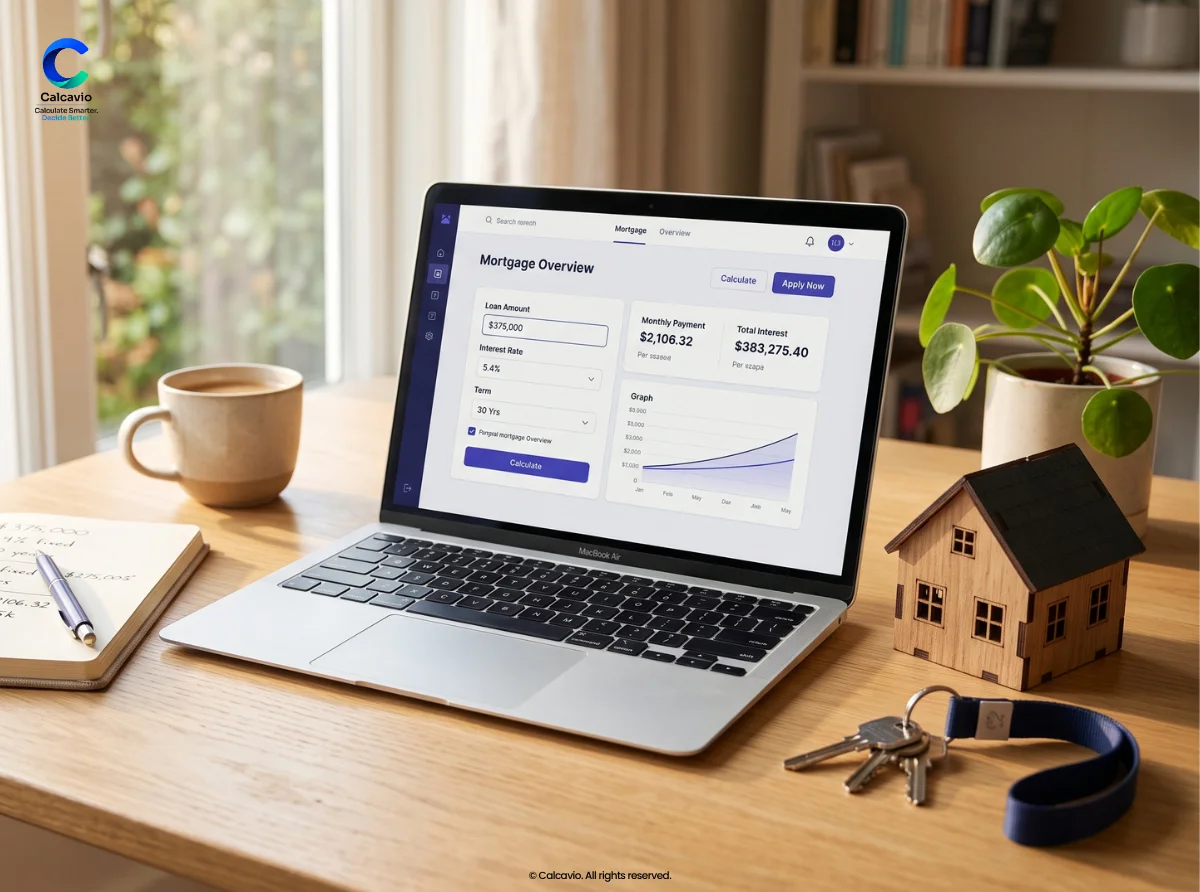
Buying a home is the biggest number most people ever sign for. Worse, the real cost hides in plain sight. The sticker rate is only the start. In fact, taxes, insurance, points, and the loan term all change what you pay. Fortunately, a good mortgage calculator strips that fog away in seconds. This guide walks through all 21 mortgage calculators on Calcavio. For each one, it shows the exact formula. It then runs the numbers with real 2026 rates. As a result, you can see where the money really goes. Want the fast version? Run your numbers in our Mortgage Payment Calculator and follow along.
TL;DR
In this guide:
What is a mortgage calculator?
A mortgage calculator turns three inputs into two answers. You enter your loan amount, interest rate, and loan term. In return, it gives you a monthly payment and a total-interest figure. Most tools also add property tax, home insurance, and mortgage insurance. Together, those pieces form your true monthly cost - the number lenders call PITI (principal, interest, taxes, insurance).
Here's the part worth knowing. Nearly every mortgage tool is built on one equation. Learn it once, and the other 20 calculators stop feeling like magic.
The one formula behind almost every mortgage calculator
The standard amortizing-loan payment formula is the engine under the hood:
M = P × [ r(1 + r)^n ] / [ (1 + r)^n − 1 ]

M = monthly payment
P = loan principal (amount borrowed)
r = monthly interest rate = annual rate ÷ 12
n = total number of monthly payments = years × 12
Worked example (2026): Borrow $300,000 at a 6.5% fixed rate for 30 years. Then r = 0.065 ÷ 12 = 0.0054167 and n = 360. Plug in, and M ≈ $1,896 per month. Over the full term, you pay about $682,560. Of that, roughly $382,633 is interest - more than the house itself. For reference, check Freddie Mac's weekly rate survey. It put the average 30-year fixed rate at 6.58% in late July 2026.
Use our free Mortgage Payment Calculator above - no formula needed. Now, the 21 tools, grouped by the job they do.
Payment & schedule calculators
Together, these five answer the everyday question: what will I pay, and how fast can I be done?
Mortgage Payment Calculator
Your baseline monthly principal-and-interest payment.
M = P × [ r(1 + r)^n ] / [ (1 + r)^n − 1 ]In addition, add your tax, insurance, and any PMI on top to get full PITI. For example, $300k at 6.5% over 30 years ≈ $1,896/month before taxes and insurance.
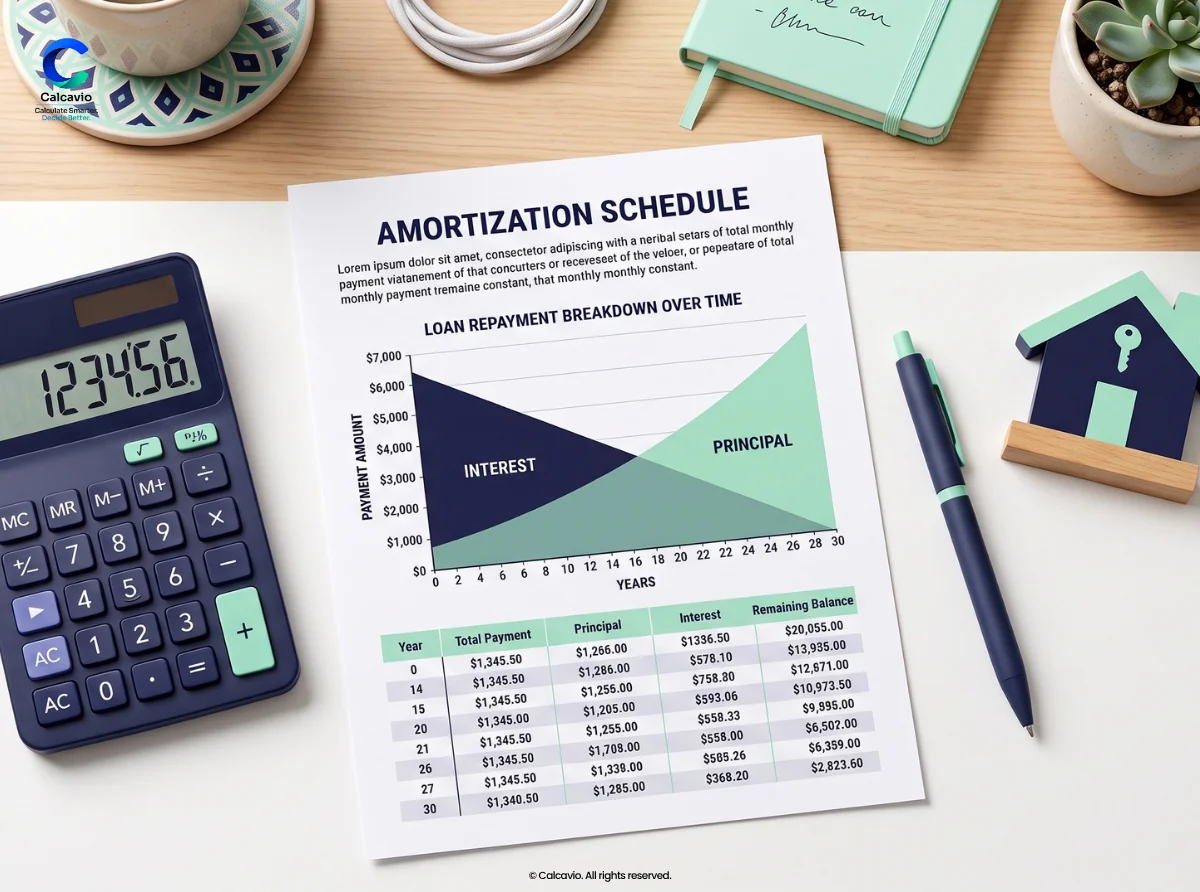
Amortization Schedule Calculator
Shows how each payment splits between interest and principal, month by month.
Interest this month = Current balance × r
Principal this month = M − Interest this month
New balance = Current balance − Principal this month
Early on, most of your payment is interest. Later, the split flips as the balance shrinks. For instance, on that same $300k loan, the first payment is about $1,625 interest and only $271 principal.
Amortization Schedule Calculator
Extra Mortgage Payment Calculator
Shows how adding to each payment shortens the loan and cuts interest.
New payoff term:  n = −ln( 1 − (r × B) / (M + E) ) / ln(1 + r)
Interest saved = original total interest − new total interest

B = current balance,  E = extra amount added each month
Even $200 extra a month adds up fast. For instance, on a $300k loan, it can save tens of thousands in interest and knock years off the term.
Extra Mortgage Payment Calculator
Biweekly Mortgage Calculator
Models paying half your monthly amount every two weeks instead of once a month.
Biweekly payment = Monthly payment ÷ 2
26 biweekly payments per year = 13 monthly payments (one extra per year)
That single extra annual payment adds up. Typically, it trims a 30-year loan by four to six years with no dramatic lifestyle change.
Mortgage Payoff Calculator
Tells you how many months are left to clear a balance at a set payment.
n = −ln( 1 − (r × B) / M ) / ln(1 + r)

B = current balance,  M = monthly payment,  r = monthly rate
This one is handy mid-loan. Simply enter today's balance and payment to see your true finish line and, importantly, how extra payments move it.
Affordability & saving-to-buy calculators
Before the payment matters, two questions come first: how much house can I afford, and how do I save the down payment?
Mortgage Affordability Calculator
Estimates the payment your income can support using the classic 28/36 rule.
Max monthly housing payment (PITI) = 0.28 × gross monthly income
Max total debt payments = 0.36 × gross monthly income
Affordable payment = the 36% cap minus your existing monthly debts
For example, on a $90,000 salary ($7,500/month), that's roughly $2,100 for housing and $2,700 for all debt combined.
Mortgage Affordability Calculator
Multi-Rule Home Affordability Calculator
Runs several lending rules at once and picks the safest answer.
Rules compared:
  • 28/36 DTI rule
  • 35/45 rule (housing ≤35% gross, total debt ≤45% gross)
  • 25%-of-net-pay rule
  • 2.5×–3× annual income price cap
Recommended budget = the LOWEST result across all rules
As a result, this stops one optimistic rule from talking you into a payment that squeezes everything else.
Mortgage Affordability Calculator
Down Payment Savings Calculator
Works out how much to set aside each month to hit a down-payment goal.
Monthly saving needed:  C = G × i / [ (1 + i)^N − 1 ]
If your savings earn 0% interest:  C = G ÷ N

G = savings goal,  N = months,  i = monthly return
For example, a 20% down payment on a $400,000 home is $80,000. To save that in five years, you'd then need roughly $1,200–$1,300 a month, depending on your savings rate.
Down Payment Savings Calculator
Rent vs. Buy Calculator
Compares the true multi-year cost of buying against renting.
Cost of buying = down payment
              + Σ(payment + tax + insurance + maintenance)
              − equity built − home appreciation
Cost of renting = Σ(rent + renters insurance)
              − investment return on the un-spent down payment
Typically, buying wins only after the break-even year. Often, that's five to seven years depending on your rate and local prices.
Loan types & program calculators
Different programs mean different math. Here, these five handle the big ones.
FHA Loan Calculator
Adds FHA mortgage insurance to the standard payment.
Upfront MIP = 1.75% × base loan amount  (usually financed into the loan)
Monthly MIP = (annual MIP rate × loan) ÷ 12
Minimum down payment = 3.5% (for credit scores 580+)
FHA loans help lower-credit and lower-down-payment buyers. For 2026, HUD set the FHA "floor" at $541,287. Meanwhile, the high-cost "ceiling" reaches $1,249,125 for a one-unit home.
VA Loan Calculator
Models a zero-down, no-PMI VA loan with its one-time funding fee.
Funding fee = funding-fee rate × loan amount
  (first use, $0 down = 2.15%; reduced if you put money down; waived for many disabled veterans)
Total loan = base loan + financed funding fee
Then apply the standard payment formula to the total loan
Because there's no down payment or PMI, the funding fee is the main trade-off. Even so, it's often rolled into the loan.
Jumbo Loan Calculator
Same amortizing math, but for loans above the conforming limit.
M = P × [ r(1 + r)^n ] / [ (1 + r)^n − 1 ]
(applies when the loan exceeds the 2026 conforming limit of $832,750 in most counties)
The formula itself doesn't change. However, jumbo loans carry stricter credit, reserve, and down-payment requirements and sometimes a different rate.
ARM Mortgage Calculator
Handles adjustable-rate loans that start fixed, then float.
During the intro period: fixed starter rate
After it adjusts:  New rate = index + margin
  (bounded by initial, periodic, and lifetime rate caps)
The new payment re-amortizes the remaining balance over the remaining term at the new rate
A 5/1 ARM, for example, is fixed for five years, then adjusts annually. In turn, the calculator shows best- and worst-case payments once the caps kick in.
Adjustable-Rate Mortgage (ARM) Calculator
Reverse Mortgage Calculator
Estimates how much a homeowner 62+ can draw from a HECM.
Principal Limit = min(home value, 2026 max claim $1,249,125) × Principal Limit Factor (PLF)

PLF rises with the youngest borrower's age and falls as the expected rate rises
There's no monthly payment; instead, the balance grows over time. Notably, the 2026 HECM maximum claim amount is $1,249,125 (HUD).
Cost & rate-lever calculators
The fees and levers that quietly change your real rate.
PMI Calculator
Estimates private mortgage insurance when your down payment is under 20%.
LTV = loan ÷ home value
Annual PMI = PMI rate (≈0.5%–1.5%) × loan amount
Monthly PMI = Annual PMI ÷ 12
PMI applies while your loan-to-value stays above 80%. Then it cancels on its own at 78% LTV. On a $300k loan, a 0.8% PMI rate adds about $200 a month - until you build equity.
Closing Cost Calculator
Totals the one-time costs due at closing.
Total closing costs = lender fees + third-party fees + prepaids + escrow deposits
Typical range = 2%–5% of the loan amount
For example, on a $300k loan, budget roughly $6,000–$15,000 - separate from your down payment.
Mortgage Discount Points Calculator
Shows whether paying points to lower your rate is worth it.
Cost of points = points (%) × loan amount
One point (1%) ≈ 0.25% lower rate (varies by lender)
Break-even months = cost of points ÷ monthly payment saved
Say a point costs $3,000 and saves $45 a month. Then you break even in about 67 months. In short, points only pay off if you'll keep the loan that long.
Mortgage Discount Points Calculator
Mortgage APR Calculator
Converts your rate plus fees into the true annual cost.
Solve for the APR where:
  Net proceeds (loan − financed fees) = Σ [ M / (1 + APR/12)^t ]  for t = 1..n
APR is always ≥ the note rate whenever fees exist
Ultimately, APR is the honest apples-to-apples number for comparing loan offers, because it bakes the fees into the rate.
Strategy & comparison calculators
The decisions that save (or cost) the most over a loan's life.
15 vs. 30 Year Mortgage Calculator
Runs the payment formula twice and compares total interest.
Run M for n = 180 (15-yr) and n = 360 (30-yr)
Total interest = M × n − P  for each term
The 15-year has a higher monthly payment. In exchange, it charges far less interest and usually a lower rate. For example, Freddie Mac had the 15-year at 5.96% versus 6.58% for the 30-year in late July 2026.
15 vs. 30 Year Mortgage Comparison
Mortgage Refinance Calculator
Tells you whether refinancing actually pays off.
Monthly savings = old payment − new payment
Break-even months = total refinance costs ÷ monthly savings
For example, if refinancing costs $6,000 and saves $200 a month, you break even in 30 months. Therefore, refinance only if you'll keep the loan past that point.
Pay Off Mortgage vs. Invest Calculator
Compares a guaranteed return against an expected one.
Guaranteed return from prepaying = your after-tax mortgage rate
Expected return from investing = your realistic after-tax portfolio return
Prepay when the mortgage rate beats your expected after-tax return; otherwise invest
With a 6.5% mortgage, paying it down is a guaranteed 6.5% return. Notably, that's a high bar for a taxable portfolio to clear reliably.
Pay Off Mortgage Early vs. Invest
Calcavio's Verdict
The verdict: For most buyers, three calculators move the needle most. First, use the Affordability tool before you shop. Then lean on the Payment/Amortization pair once you have a rate. After that, the rest simply fine-tune a decision those tools have already framed.
Best for: anyone comparing homes, rates, or loan types who wants the real monthly cost, not the sticker rate.
Skip it if: you've already locked a loan and only need exact closing figures. Instead, get those from your lender's disclosure.
Pros and cons
- Every tool runs on one transparent formula
- Worked examples pin the math to verified 2026 rates
- Covers niche cases (ARM caps, HECM, points break-even) most calculators ignore.
- Results are estimates, not quotes
- Property tax and insurance vary widely by location, so PITI is only as good as your inputs.
Standout: seeing all 21 formulas in one place makes the hidden lever obvious. Specifically, the loan term and rate drive lifetime cost far more than a small change in price. On a $300k loan, going 15-year instead of 30-year can save well over $200,000 in interest.
Frequently asked questions
What is the formula for a mortgage payment?+
How much house can I afford?+
What is PITI?+
When does refinancing make sense?+
Is a 15-year or 30-year mortgage better?+
How do I get rid of PMI?+

Conclusion
Every mortgage calculator on this page comes back to a few honest equations. And once you can see the math, the fear drains out of the biggest purchase of your life. Three steps matter most. First, figure out what you can afford. Next, model your real monthly payment. Finally, compare your term and rate options before you sign. Run your own numbers in Calcavio's mortgage calculators - free, no signup and see your true cost in seconds. Which mortgage decision are you weighing right now: buying, refinancing, or paying down faster?
Sources
- Primary Mortgage Market Survey (30-yr 6.58%, 15-yr 5.96% as of July 23, 2026) — Freddie Mac
- 2026 Conforming Loan Limit ($832,750, one-unit baseline) — FHFA
- 2026 Loan Limits (floor $541,287 / ceiling $1,249,125; HECM max claim $1,249,125) — HUD / FHA
- VA funding fee rates — U.S. Department of Veterans Affairs
- Mortgage basics (PITI, PMI, APR) — Consumer Financial Protection Bureau
Run the numbers yourself
See your exact numbers in seconds — free, no signup.
Try the Mortgage Payment CalculatorRelated Articles

Mortgage Payment Math: Rates Just Hit an 11-Month High
Mortgage rates just hit an 11-month high. Here's exactly what the ~0.26-point jump adds to your monthly mortgage payment and lifetime interest on a $300k–$400k loan - recomputed to the dollar, with a free calculator to run your own number.
Tax Calculators: Every Formula Behind All 25 Tools (2026)
Every tax calculator on Calcavio, explained with its exact 2026 formula - from US federal brackets to UK VAT, Canadian rates, and Australian GST.

Savings Calculators: All 11 Formulas Explained
Every Calcavio savings calculator explained - 11 tools, 11 formulas, 11 worked examples, from savings goals and CD ladders to 529 college plans.