

Public EV Charging Break-Even Price: Compare With Gas
Find the public-charging rate that matches your gas car’s fuel bill. Use a billed-energy worksheet to account for charging losses, session charges, and local tariff conditions.
 Nathan Cole
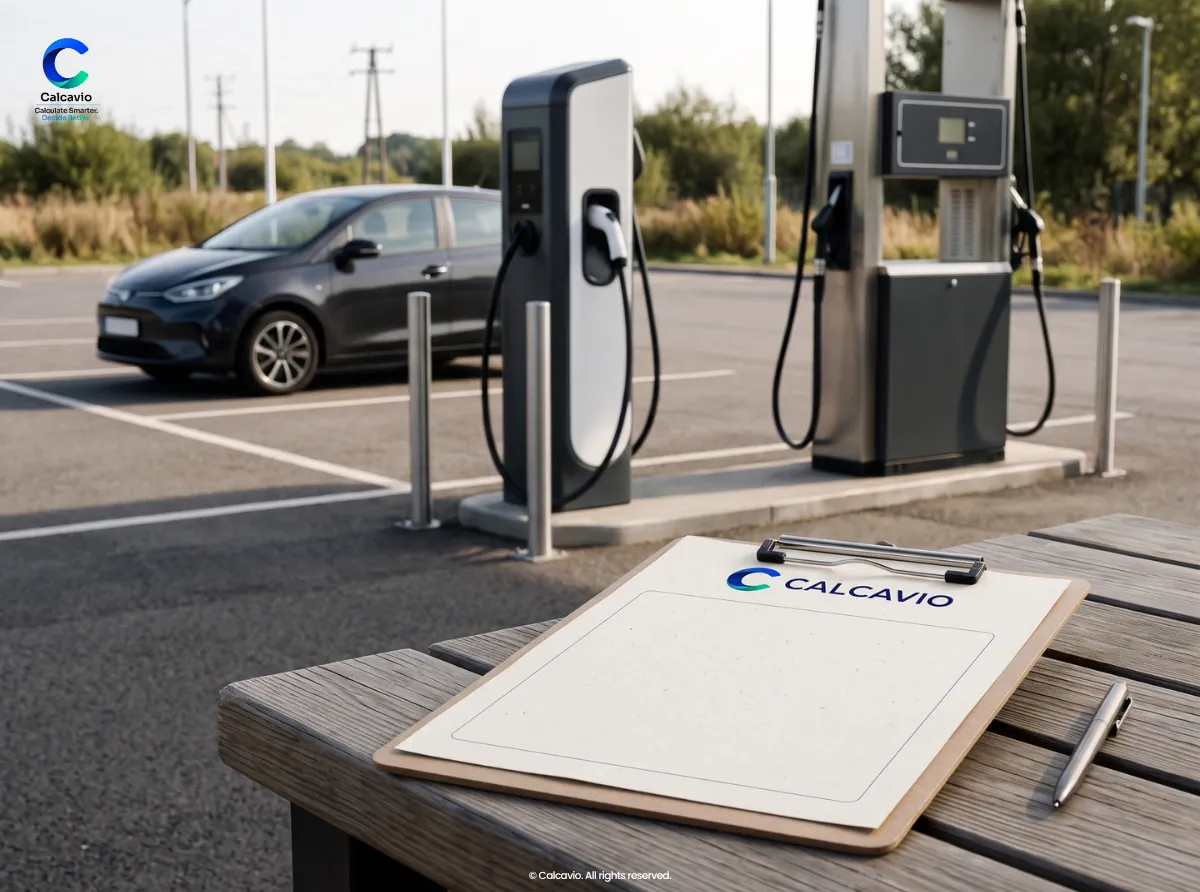
Your public EV charging break-even price is the most you can pay per billed kilowatt-hour before electricity matches your gas car's fuel bill. If you don't have dependable home charging, that number matters more than a low overnight rate you can't use.
AAA's October 22, 2026 release reported regular gasoline at $4.2701 per US gallon and average public charging at $0.41/kWh. Those dated national figures provide context, not a quote for your next stop. Instead, compare your own pump price, MPG, and charging receipt.
What did AAA's latest checked release report?
AAA's October 22, 2026 release reported $4.2701 per gallon for regular gasoline and $0.41 per kWh for public charging. For an assumed 40-MPG car and an EV using 30 billed kWh per 100 miles, those prices imply a break-even threshold near $0.356/kWh before separate charges—not a universal EV verdict.
The older October 15 release used $4.3344 per gallon. Its threshold was $0.3612/kWh under the same assumptions. However, neither release identifies its public average as a DC-fast-only tariff. Don't apply that average to every charger.
For a basic same-distance comparison, Calcavio's Fuel Cost Calculator provides gas and EV inputs. Keep the fee adjustments below beside your result.
Fuel Cost Calculator: Trip, Commute & EV Costs
How do you calculate your public EV charging break-even price?
First, calculate gasoline cost per mile. Then divide it by billed EV energy per mile:
All-in break-even rate = gas price ÷ US MPG ÷ billed kWh per mile.
Here, “all-in” means the full charging rate after spreading tax and charging fees over the billed energy. It does not mean all car costs.
For this worked example, assume 100 miles, 40 US MPG, and 30 billed kWh. Use AAA's dated October 22 gas price, not an assumed current local price:
- Gas used: 100 ÷ 40 = 2.5 US gallons.
- Gas cost: 2.5 × $4.2701 = $10.67525, displayed $10.68.
- EV energy cost: 30 × $0.41 = $12.30.
- EV extra energy cost: $12.30 − $10.67525 = $1.62475, displayed $1.62.
- All-in threshold: $10.67525 ÷ 30 = $0.355841666…/kWh, or about 35.6 cents/kWh.
Therefore, charging below that threshold costs less for these inputs; charging above it costs more. The 40-MPG comparator represents an efficient gas car, not the whole gas fleet. Likewise, 30 billed kWh is an example assumption, not every EV's consumption.
If you need your gas car's measured MPG first, use the MPG / Gas Mileage Calculator. Then recalculate your public EV charging break-even price when MPG or gas prices change.
MPG / Gas Mileage Calculator: Cost & Driving Range
Which numbers belong in the tariff worksheet?
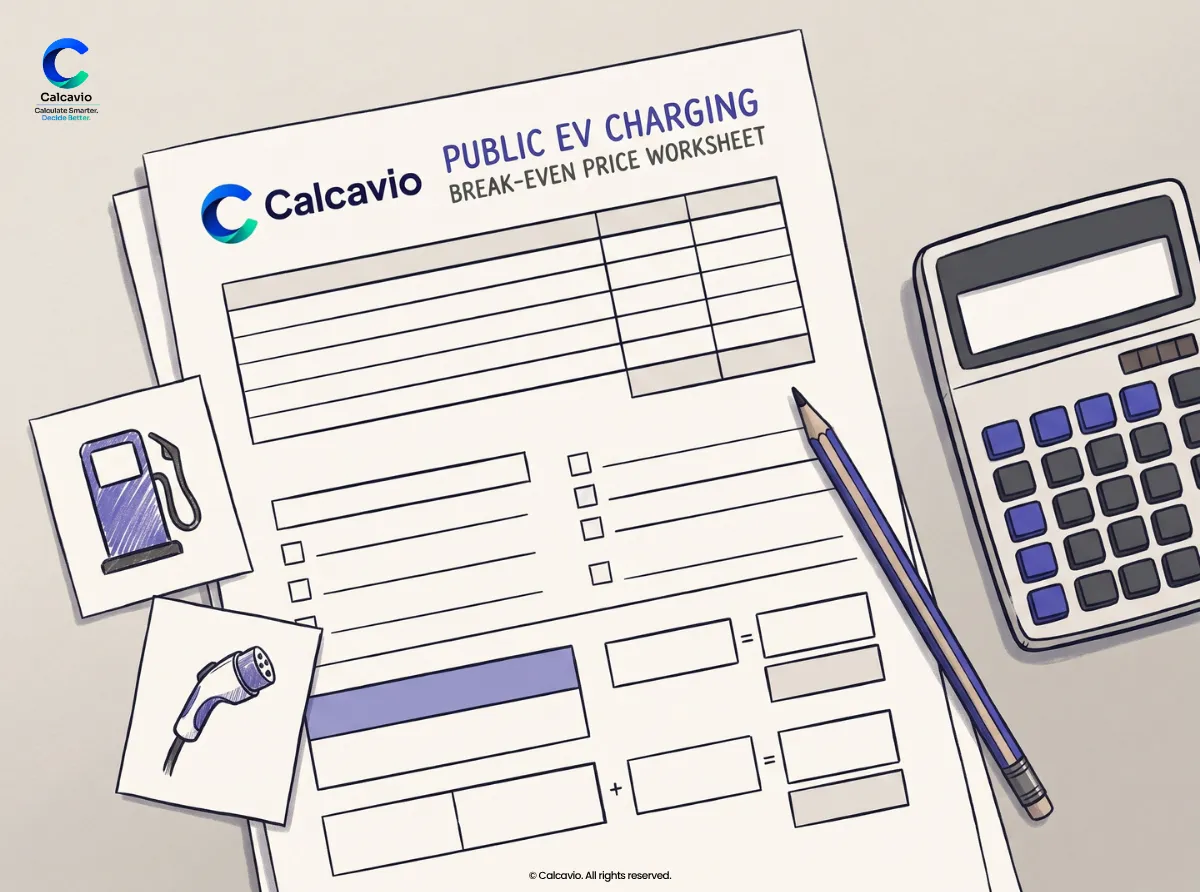
Use this public EV charging break-even price worksheet for one defined distance and its replacement energy. Then keep every fee tied to that same energy and distance.
| Input or result | Fill in your value | Worked illustration |
|---|---|---|
| Gas price, G | $___ per US gallon | $4.2701, dated AAA observation |
| Gas economy, M | ___ US MPG | 40, assumption |
| Comparison distance, D | ___ miles | 100, assumption |
| Billed energy, E | ___ kWh for D miles | 30, assumption |
| Extra charging charges, F | $___ for E kWh | $2, hypothetical |
| Gas cost, C = D ÷ M × G | $___ | $10.67525, derived |
| Maximum energy tariff = (C − F) ÷ E | $___/kWh | $0.289175, derived |
| Actual effective rate = total charging cost ÷ E | $___/kWh | Use your receipt |
With the hypothetical $2 charge, the listed energy rate must be at or below 28.9175 cents/kWh to match gas. At that exact rate, 30 × $0.289175 + $2 = $10.67525. Thus, a rounded 29-cent tariff is slightly above break-even, not exactly equal.
For your public EV charging break-even price, allocate membership fees across the month's qualifying billed kWh. Don't place the entire subscription on every session. Conversely, don't claim its discounted energy price while ignoring the subscription cost.
If F exceeds the comparison gas bill, even free electricity cannot make that session cheaper within this model. Keep unrelated parking costs separate unless charging causes that extra expense.
How do billed energy and charging losses differ?
Billed kWh is the energy quantity used for your bill. Battery use is not automatically the same quantity. DOE/EPA explains that charging losses vary with the vehicle, charging equipment, battery state, and weather.
For example, suppose battery-side use is 30 kWh per 100 miles and the relevant billed-to-battery efficiency is an assumed 90%. Then billed use is 30 ÷ 0.90 = 33.333… kWh, not 30 × 1.10. The no-extra-fee threshold falls to $0.3202575/kWh.
That 90% is a teaching assumption, not a fixed loss rate for all cars. If your starting consumption already includes the relevant charging losses, don't divide again. For public DC charging, also check where the operator measures billed energy; don't automatically add upstream station losses you aren't billed for.
As a result, your public EV charging break-even price should use a clear billed-energy basis. EPA's label guide explains kWh per 100 miles, but a dashboard number still needs a clear definition.
What does a documented local tariff change?
Cary, North Carolina, announced a $0.20/kWh rate for Town-owned public stations, effective August 1, 2026. Its July 13 release also states a $10-per-hour idle fee after three hours of charging and a 15-minute grace period, with a $100 maximum daily charge.
For an assumed 30-billed-kWh session, energy alone costs $6. By contrast, adding one full chargeable hour at the stated idle rate gives $16 before other applicable charges. That exceeds the worked gas bill of $10.67525. The session is assumed to replenish the same 100 miles; this is not a measured vehicle test.
However, the release does not confirm whether tax is included. It also does not set out all access or plan rules, or rates split by charger type. It describes smartphone access and payment, not a checked plan discount. Therefore, confirm the selected station's app quote, parking rules, fee increments, and current terms before treating either subtotal as your full bill. Access checked October 25, 2026.
Why isn't this a total ownership-cost verdict?
A cheaper charging session doesn't settle which vehicle is cheaper to own. The worksheet leaves out the car price, loss in resale value, loan costs, insurance, repairs, and car taxes. It also leaves out charging access and the value you place on waiting or detours.
For a wider car budget, the Car Affordability Calculator can support a separate exercise. Don't mistake its budget outputs—or this energy threshold—for a full cost-of-ownership study.
Car Affordability Calculator: How Much Car Can I Afford?
Calcavio's Verdict
Compare the full receipt with your threshold, not the headline energy price.
Best for: drivers without reliable home charging.
Skip it if: you need a complete purchase or ownership comparison.
Pros and cons
- Clear units; clear math; explicit fee allocation.
- Needs a fair energy-use figure; can't predict availability or future tariffs.
Standout: a small session charge can turn an apparently competitive tariff into the more expensive option.
Frequently asked questions
Is public charging always more expensive than gas?+
Can I compare a per-minute charger with this threshold?+
What if I use several charging networks?+
What should you do before your next charging stop?
First, check your pump price and measured MPG. Next, establish billed energy for a matching distance. Finally, compare the complete charging quote with your public EV charging break-even price.
Use Calcavio's gas-versus-EV comparison, then complete the fee worksheet. Which charge on your receipt changes the answer most?
Fuel Cost Calculator: Trip, Commute & EV Costs
Sources
- Main dated gas/public-charging context. — AAA Release (October 22, 2026)
- Historical example. — AAA Release (October 15, 2026)
- Ahecked for newer releases. — AAA (October archive)
- August 1 rate and idle conditions. — Cary, North Carolina (July 13, 2026)
- Mechanism/variability — DOE/EPA Losses
- kWh/100 miles — EPA EV label
Find our calculators and guides useful? Add Calcavio as a preferred source on Google.
Latest Articles
84-Month Car Loan: Run the Three-Year Exit Test
A lower monthly payment does not guarantee an easy sale. Compare payment-36 debt with offers, selling costs and available cash using a three-year exit worksheet.
Car Clearance Discount: 2026 vs. 2027 Break-Even Test
Compare a 2026 clearance price with a 2027 car’s financing and assumed resale value. This worksheet shows the discount needed to break even at the same sale date.

New vs Used Car Financing Break Even: Find Your Price
A lower used-car price can still mean higher loan repayments. Compare matched offers, find the used borrowing threshold, and check ownership costs separately.