
Mortgage Payment Math: Rates Just Hit an 11-Month High
Mortgage rates just hit an 11-month high. Here's exactly what the ~0.26-point jump adds to your monthly mortgage payment and lifetime interest on a $300k–$400k loan - recomputed to the dollar, with a free calculator to run your own number.
 Nathan Cole10 min read
The number on your rate lock moved this month, and not in your favor. The average 30-year fixed mortgage climbed from 6.43% at the start of July to 6.55% by July 16, then the Mortgage Bankers Association pegged the conforming 30-year at 6.69% a week later - the highest reading since last August. Blame the Middle East: renewed strikes pushed oil higher, oil pushed inflation fears higher, and Treasury yields (which mortgage rates shadow) followed. Here's the part the headlines keep skipping. A quarter-point sounds like a rounding error until you turn it into dollars. So let's do the math nobody else is publishing - what this roughly 0.26-point jump actually adds to your monthly payment and to the interest you'll pay over the life of a $300,000 to $400,000 loan. Your mortgage payment is the real story, not the rate.
Why did mortgage rates jump to an 11-month high?
TL;DR
Mortgage rates hit an 11-month high in July 2026. The cause? Specifically, renewed Middle-East conflict drove oil prices up. That, in turn, stoked inflation worries and lifted the 10-year Treasury yield that fixed mortgage rates track. Then Freddie Mac put the 30-year at 6.55% on July 16. Soon after, the MBA measured 6.69% - both the highest since August 2025.
Mortgage rates don't take orders directly from the Federal Reserve. Instead, they mostly follow the 10-year Treasury yield. Moreover, that yield jumps whenever investors smell inflation. For example, in early July, a fresh flare-up of strikes in the Middle East sent oil prices climbing. As a result, U.S. gas prices spiked about 15 cents in a single week. Meanwhile, traders priced in the risk that pricier energy would keep inflation sticky. So yields rose, and the average home loan rate rode along.
Stat callout
According to Freddie Mac's Primary Mortgage Market Survey (July 16, 2026), the 30-year fixed-rate mortgage averaged 6.55%. That's up from 6.43% on July 2, and it's the highest reading since August 2025. In fact, a year earlier the same survey read 6.75%.
Meanwhile, the Mortgage Bankers Association surveys actual application rates, and it went higher still. Its 30-year conforming contract rate hit 6.69% for the week ending July 17, 2026 - an 11-month high, per Reuters. In short, the two gauges use different methods but point the same direction: up. In addition, Freddie Mac's chief economist Sam Khater noted that purchase demand has softened even as housing inventory improves. Still, that's a small silver lining for buyers willing to negotiate.
What does the 0.26-point move actually do to your payment?
Now, this is the recompute the news is skipping. Specifically, between July 2 (6.43%) and July 22 (6.69%), the 30-year climbed about 0.26 percentage points. On paper, that's tiny. In your budget, though, it stings. So here's the monthly and lifetime damage on a standard 30-year fixed home loan. (These figures are principal and interest only - taxes, insurance, and PMI sit on top.)
The cost of the July 2026 rate climb (6.43% → 6.69%, 30-year fixed, P&I)
| Loan amount | Extra per month | Extra per year | Extra lifetime interest |
|---|---|---|---|
| $300,000 | +$51.43 | +$617 | +$18,515 |
| $350,000 | +$60.00 | +$720 | +$21,601 |
| $400,000 | +$68.57 | +$823 | +$24,686 |
Read that last column again. Indeed, on a $400,000 loan, a move most people would call a rounding error quietly adds nearly $25,000 in interest over 30 years. That's roughly a new car, handed to your lender. Consequently, locking a rate a few weeks apart at the same house and same price can mean very different lifetime costs.
How is a mortgage payment actually calculated?
Every fixed-rate mortgage payment comes from one formula the amortizing-loan equation. Once you see it, the rate sensitivity above stops feeling like magic.
M = P × [ r(1 + r)^n ] ÷ [ (1 + r)^n − 1 ]

Here's what each symbol means:
M = monthly principal and interest,
P = loan principal,
r = monthly interest rate (annual rate ÷ 12), And
n = number of payments (years × 12).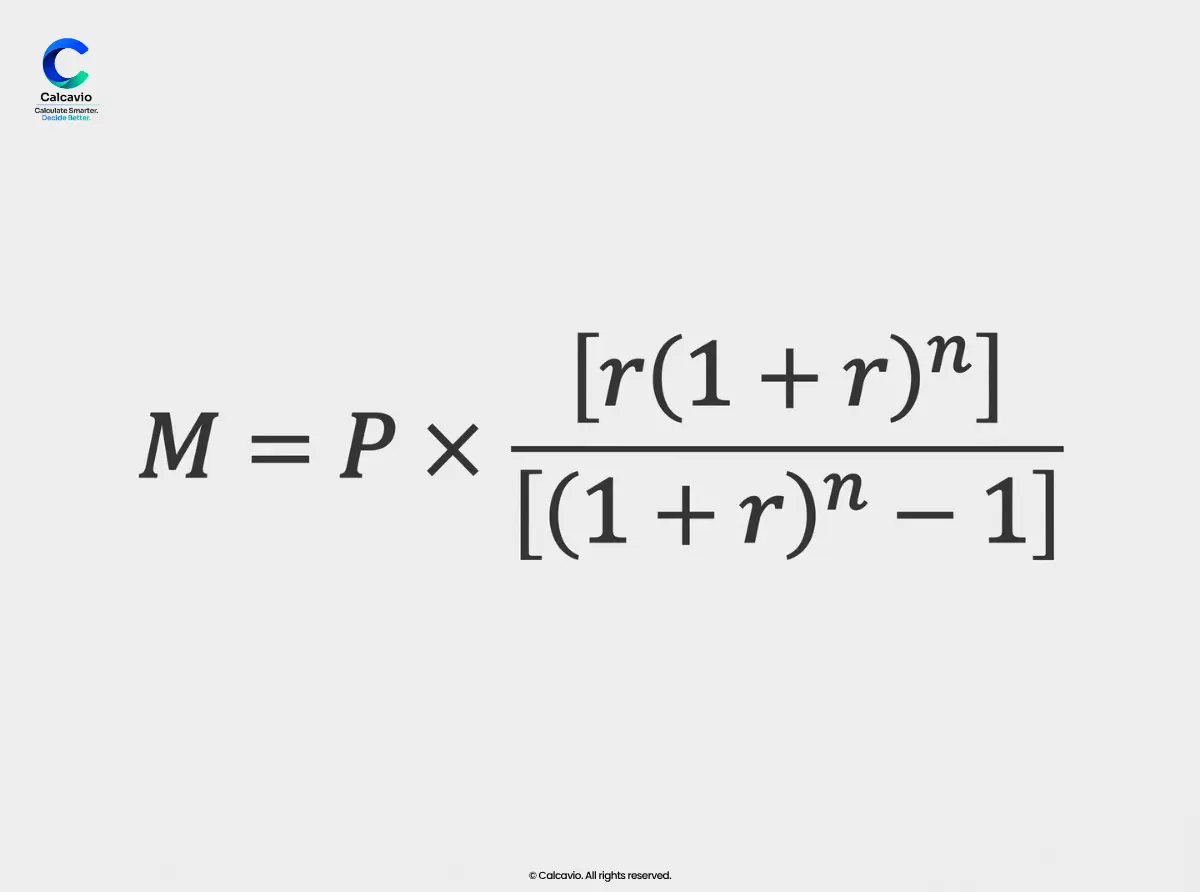
Calculate your monthly payment on a $300,000 loan at 6.55%
- First, set your principal. P = $300,000.
- Next, convert the rate to monthly. 6.55% ÷ 12 = 0.0054583 (that's r).
- Then count the payments. 30 years × 12 = 360 months (that's n).
- After that, apply the formula. Plug P, r, and n into the equation above.
- Now read the result. M = $1,906.08 per month in principal and interest.
- Finally, find lifetime interest. $1,906.08 × 360 = $686,189 paid, minus the $300,000 borrowed = $386,189 in interest.
Stat callout
Likewise, Freddie Mac's own illustration lines up with the math. A $300,000 loan runs about $1,896/month at 6.5% versus about $1,996/month at 7%. That's a $100 monthly swing from a half-point. In fact, our verified figures land at $1,896.20 and $1,995.91 matching to the dollar.
$300k vs $350k vs $400k: your real monthly payment now
First, here's the full picture at each recent rate milestone, so you can find the row closest to your loan. Again, this is principal and interest only. Moreover, your true monthly cost (PITI) adds property taxes, homeowners insurance, and PMI if you put less than 20% down.
Monthly P&I by loan size and rate (30-year fixed)
| Loan | 6.43% (Jul 2) | 6.55% (Jul 16) | 6.69% (Jul 22) | 7.00% |
|---|---|---|---|---|
| $300,000 | $1,882.41 | $1,906.08 | $1,933.84 | $1,995.91 |
| $350,000 | $2,196.15 | $2,223.76 | $2,256.15 | $2,328.56 |
| $400,000 | $2,509.89 | $2,541.44 | $2,578.46 | $2,661.21 |
Notably, the gap widens as the loan grows. The same 0.26-point move raises the house payment for a $300k borrower by about $51 a month. For a $400k borrower, though, the monthly payment climbs nearly $69 - because interest is charged on a bigger balance. So if you're shopping at the top of your budget, you feel rate moves the hardest.
Micro-scenario
Picture this. You're pre-approved for a $350,000 home loan, and you found the house in late June, when your lender quoted 6.43%. Then you waited two weeks to make an offer. At 6.69%, your payment just jumped $60 a month - $720 a year. Over the life of the loan, that's about $21,600, for the exact same house at the exact same price. Nothing changed except the calendar. So that's the moment the math matters. It's also the moment to run your own numbers rather than trust a stale quote.
Run your real payment in seconds with our free Mortgage Payment Calculator - enter your loan amount and today's rate, no formula and no signup needed. Then stress-test it: bump the rate a quarter-point to see your buffer before you lock.
What can you do when rates spike?
- First, shop at least three lenders. On a big home loan, an eighth of a point is real money. Indeed, the MBA's own survey shows lenders quoting different rates and points in the same week.
- Second, weigh paying points if you'll stay put long enough to break even. Otherwise, skip them if you might move or refinance soon.
- Next, check your affordability at the new rate, not last month's. Specifically, use the House Affordability Calculator to reset your ceiling.
- Also, model extra payments. For instance, even $100 a month against principal can offset part of a higher rate — see it on the amortization schedule.
- Finally, keep a refinance trigger in mind. If rates later fall enough to cover closing costs, refinancing can claw back some of today's premium. Of course, consult a professional before deciding.
Calcavio's Verdict
The verdict:
A quarter-point looks trivial and isn't on a $300k–$400k loan the July 2026 climb adds roughly $50–$70 a month and $18,500–$24,700 in lifetime interest, so recompute before you lock, don't eyeball it.
Best for:
Buyers actively shopping or about to lock, and anyone comparing quotes a few weeks apart.
Skip it if:
You're already locked at a lower rate - sit tight; chasing tiny moves after the fact isn't worth the stress.
Pros and cons
- the cost of a rate move is knowable to the dollar · shopping lenders can recover much of the increase · higher inventory gives buyers more negotiating room right now.
- rates are volatile and geopolitics can move them fast · a bigger loan magnifies every basis point.
Standout:
Notably, most coverage stops at "rates hit an 11-month high." The number that actually matters is this: ~0.26 points equals nearly $25,000 in extra interest on a $400k loan. That's the recompute to internalize.
Calcavio Editorial Score:
Frequently asked questions
How much does a 0.25% rate increase add to a mortgage payment?+
What is the monthly payment on a $300,000 mortgage in 2026?+
Why do mortgage rates follow oil prices and the Middle East?+
Should I lock my mortgage rate now or wait?+
What's the difference between the Freddie Mac and MBA mortgage rates?+
Does a bigger loan get hit harder by a rate increase?+
The bottom line
Rates hitting an 11-month high isn't just a headline. Instead, it's a line item in your budget for the next 30 years. The takeaways are simple. First, a quarter-point is worth tens of thousands over the life of a big loan. Second, a larger balance feels every move more sharply. And third, shopping lenders can win back much of the increase. So don't guess, and don't trust a quote from three weeks ago.
Recalculate your real number now with our free Mortgage Payment Calculator - then compare it against your budget before you lock. Sitting where you can control it beats reacting to the next headline. What rate are you seeing from your lender this week?
Disclaimer
Sources
- 30-year fixed average, highest since August 2025 — Freddie Mac
- MBA conforming rate 6.69%, week ending July 17 — Reuters
- Conforming 30-year contract rate 6.69% — Mortgage Bankers Association
- Sam Khater quote; 11-month high context — Realtor
- Oil/gas prices and Treasury-yield link — CNN Business
- Borrower guidance (background) — Consumer Financial Protection Bureau
Run the numbers yourself
See your exact numbers in seconds — free, no signup.
Try the Mortgage Payment CalculatorRelated Articles
Mortgage Calculators: Every Formula and Tool for 2026
The 21 mortgage calculators every buyer needs and the exact formula behind each, with worked 2026 examples using verified rates and loan limits.
Tax Calculators: Every Formula Behind All 25 Tools (2026)
Every tax calculator on Calcavio, explained with its exact 2026 formula - from US federal brackets to UK VAT, Canadian rates, and Australian GST.
Savings Calculators: All 11 Formulas Explained
Every Calcavio savings calculator explained - 11 tools, 11 formulas, 11 worked examples, from savings goals and CD ladders to 529 college plans.